

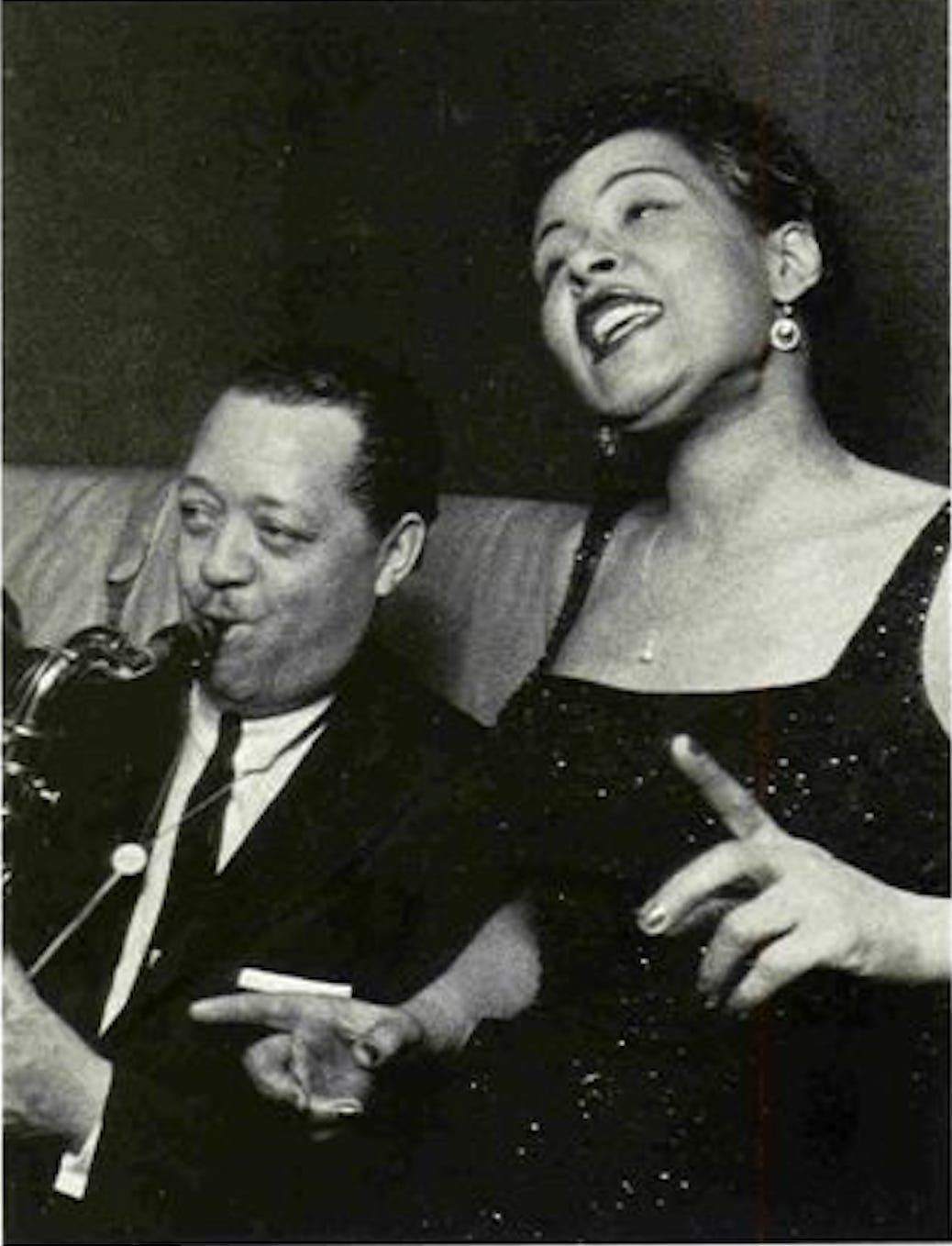
Billie Holiday is jazz’s finest and most meaningful singer. Born 111 years ago today, she revolutionized jazz vocalizing with a style that was all her own. She embodied the sound and emotionalism of jazz, the way Armstrong did before her on the trumpet, and you know it’s her the moment you hear her voice. [Photo above of Billie Holiday and Lester Young]
Today, I thought I’d assemble five major reasons why Holiday remains significant and why her voice best exemplifies the spirit and soul of jazz:
1. Songbook pioneer—While Ella Fitzgerald is commonly referred to as the First Lady of Song and most closely identified with jazz interpretations of the American songbook, Holiday began the trend in November 1933—a year earlier than Fitzgerald’s career-launching win on Amateur Night at Harlem’s Apollo Theater.
Age 14 at the time, Holiday recorded Your Mother’s Son-in-Law with Benny Goodman for Columbia producer John Hammond. The song was written by Alberta Nichols and her husband, Mann Holiner, and the recording was Holiday’s first. Her 78 of Love Me or Leave Me (Gus Kahn and Walter Donaldson), also with Goodman, followed in December.
Here’s Holiday singing Your Mother’s Son-in-Law in 1933…
2. Courage—Billie Holiday was fearless in the face of the racial climate in the 1930s and ‘40s. Not only did she record with Goodman in the early 1930s but she also recorded with Artie Shaw and His Orchestra in July 1938, after he hired her in March as his lead female vocalist.
With Any Old Time a huge hit, the Shaw band and Holiday hit the road. She became one of the first black female vocalists to tour the South with an all-white band. Before long, Holiday left as pressure from Shaw’s nervous management team increased and Shaw himself kept her off the bandstand to avoid problems with audiences.
Here’s what Holiday told writer Dave Dexter in Down Beat magazine in 1939:
“At first, we worked together OK. Then his managers started belly-aching. Pretty soon it got so I would sing just two numbers a night. When I wasn’t singing, I had to stay backstage. Artie wouldn’t let me sit out front with the band.
“Last year [1938], when we were at the Lincoln Hotel, the hotel management told me I had to use the back door. That was all right. But I had to ride up and down in the freight elevators, and every night Artie made me stay upstairs in a little room without a radio or anything all the time.
“Finally it got so I would stay up there, all by myself, reading everything I could get my hands on, from 10 to nearly 2 in the morning, going downstairs to sing just one or two numbers. Then one night ... Artie said he couldn’t let me sing. I was always given two shots on each program.
“The real trouble was this: Shaw wanted to sign me to a five-year contract and when I refused, it burned him. He was jealous of the applause I got when I made one of my few appearances with the band each night.”
In April 1939, just months after leaving Shaw, Holiday recorded Strange Fruit for Commodore. The song protested the lynching of blacks, with lyrics likening the dead bodies to fruit hanging from the trees. Ahmet Ertegun, co-founder of Atlantic Records, called the song “the beginning of the civil rights movement.”
Here’s Any Old Time (1938), featuring Billie Holiday…
3. Emotional—Holiday was jazz’s first vocal storyteller. Her singing style was so impassioned and heartfelt that the narrative’s events in songs sounded as if they had actually happened to her. The approach was so personal and touching that she caused jazz musicians to drop their machismo and deliver their music more emotionally.
Here’s Billie Holiday live in 1957 on CBS’s The Sound of Jazz singing Fine and Mellow, with solos, in order, by Ben Webster, Lester Young, Vic Dickenson, Gerry Mulligan, Coleman Hawkins and Roy Eldridge. They may have been on network TV reaching millions but the musicians had an audience of one—Holiday…
4. Inspiring—Generations of jazz singers and musicians have credited Holiday’s vocal phrasing and her coming in behind or ahead of the beat as being ahead of the curve.
As Frank Sinatra noted in a July 1958 essay he wrote for Ebony magazine:
“From the days of my childhood I’ve been listening to sounds and singers, both colored and white, and absorbing a little bit here and a little bit there. But it is Billie Holiday, whom I first heard in 52nd Street clubs in the early 1930s, who was and still remains the greatest single musical influence on me. It has been a warm and wonderful influence, and I am very proud to acknowledge it.”
Singer Helen Merrill revered Holiday, particularly her depth of feeling and how she interpreted songs. The feeling was mutual. Here are Merrill and Holiday in November 1956 at a party at writer-producer-pianist Leonard Feather’s New York apartment singing a duet on You Go to My Head, with Feather on piano. Dig Merrill’s reverence for space and air…
5. Struggle—From Holiday’s battle with drug and alcohol addiction to her miserable romantic relationships and wrenching 1956 memoir Lady Sings the Blues, written with William Dufty, she lived the music and gave it everything she had. What every jazz musician and singer respects about Holiday was her commitment and determination.
In February 1958, in one of her final recording sessions before her death on July 17, 1959, she recorded The End of a Love Affair, a song she didn’t know but managed to feel her way along. From my 2009 post on Lady in Satin:
“Billie admitted on-mic that she didn’t know The End of a Love Affair, and she needed multiple retakes. Finally, arranger-conductor Ray Ellis decided to record the orchestra alone, with Billie adding her vocal later using a headset to hear the playback. The arrangement is so powerful and so perfectly matched to Billie’s voice that the treatment breaks your heart.”
Here are composite takes 1 through 4 of The End of a Love Affair—including the orchestral take…
Here are composite takes 5 through 7 overdubbed to the orchestral recording…
And here’s the master (take 8) that appeared on the stereo LP…
That Sinatra quote is a great reminder of her reach. We often pigeonhole Billie as a "jazz singer," but seeing her direct impact on a giant like Sinatra really puts her singular status into perspective.
The recent book “Bitter Crop” by Paul Alexander is a fascinating read. Ostensibly, the book is about the tumultuous last year of Billie’s life, but of course is much more than that. A revelation for me was the fact that Billie did not view her life as tragic, and even toward the end was planning for the future. She even gave up alcohol for a while when her doctor recommended she do so. Ultimately, her courageous decision to perform “Strange Fruit” put the FEDS on her case for the remainder of her days.