

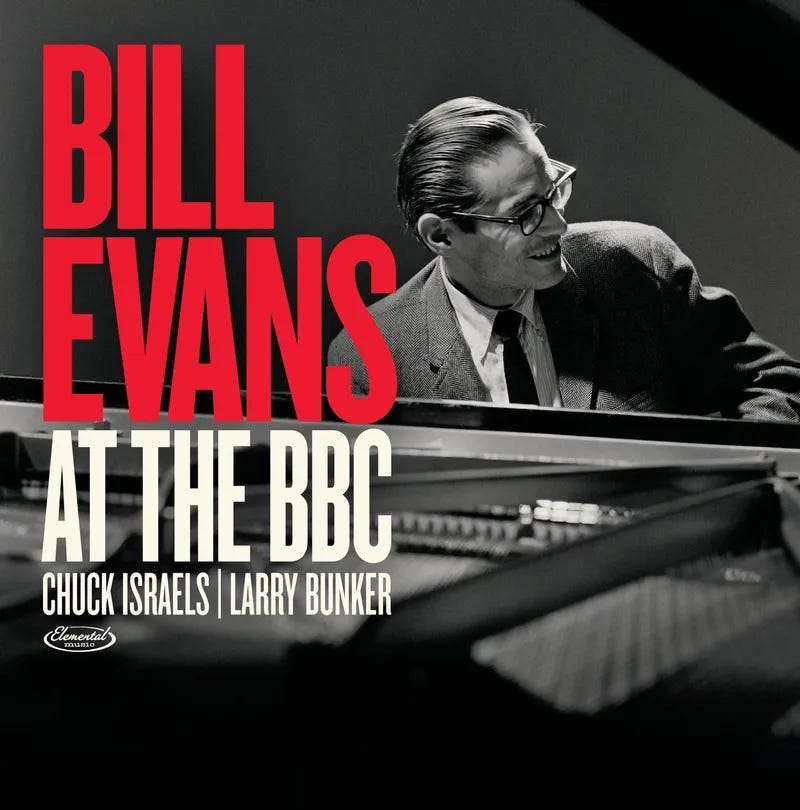
For years, you’ve watched the videos on YouTube of the Bill Evans Trio performing at the BBC in 1965. Now Elemental Music is releasing the music on a 180-gram, 2-LP deluxe set for Record Store Day on April 18 and one CD and digital download on April 24. The vinyl will be available only on Record Store Day.
I wrote the main liner notes for this release and interviewed Chuck Israels for his recollections and insights. As he said to me during our conversation: “Yes, we were damn near perfect at the BBC.”
To give you a feel for the glorious music on the upcoming release, I figured I’d share my liner notes up until the track-by-track breakdown:
Bill Evans performed at Britain’s BBC TV studios just once—on March 19, 1965. The TV show, “Jazz 625,” was taped at the BBC Television Theatre, a fanciful building designed by Frank Matcham in the Shepherd’s Bush section of West London. The music hall went up in 1903 and was acquired by the BBC in 1953. Today, it’s a popular music venue known as O2 Shepherd’s Bush Empire.
“Jazz 625” aired on BBC2 from 1964 to 1966. The show’s odd name referred to the 625-lines UHF on which the BBC Two broadcast rather than the 405-lines VHF system used by other channels. The series was conceived immediately after the resolution of a long-running feud between the American Federation of Musicians and Britain’s Musician’s Union. For years prior, the U.S. had prohibited British artists and bands from performing in the States to protect American musicians from losing out on those paying jobs. The British union did the same in the U.K. All singers were exempt since they weren’t members of either musicians union.
In late 1963, those union bans became problematic with the meteoric rise of the Beatles. British EMI wanted the band to tour in the U.S. in support of their first American album, “Meet the Beatles,” on its Capitol subsidiary. The AFM agreed to let all British artists tour in the U.S., provided American musicians could open for them. Britain won the same arrangement in the U.K.
“Jazz 625” was a beneficiary of this truce. The series launched in April 1964 to showcase American and British jazz artists on television. Episodes were telerecorded onto 35mm film, which is why they look so crisp. Tickets could be purchased for the tapings, and the studio seated around 100 people. In March 1965, when the Bill Evans Trio performed, the show’s acerbic host was jazz trumpeter and clarinetist Humphrey Lyttelton.
The Bill Evans Trio that appeared that day for taping was Evans’s second working group and featured Evans on piano, Chuck Israels on bass and Larry Bunker on drums. Israels and Bunker had replaced Evans’s first trio—bassist Scott LaFaro and drummer Paul Motian. Israels joined in 1961 following the death of LaFaro at age 25 in an auto accident. Bunker took over the drum chair from Motian after he departed in 1963 to play with pianist Paul Bley.
The Second Trio’s appearance on “Jazz 625” took place midway through their four-week run at London’s Ronnie Scott’s Jazz Club and came a month after the trio’s recording in February 1965 of “Trio ’65” (Verve), which wouldn’t be released until June. Earlier in the tour, the trio performed in Paris.
The music on this album will be familiar to many Bill Evans fans. The “Jazz 625” performance was released on DVD in the early 2000s and video clips have been up on YouTube for many years. So why issue the music now on audio? Hearing this music remastered, without the video, is a fascinating listen. Without the visual, you are forced to listen in a more attentive and granular way.
Rather than hear the music as background to what you are seeing, you feel it and the trio’s excellence more deeply. Upon listening to the music on this album, I gasped. The trio here is at its peak, playing music that is un-rushed, caressing and gorgeous. “Yes, we were damn near perfect at the BBC,” said Israels in an interview for these notes. “We were playing music that was deeply familiar, which was freeing and comforting.”
London, at this point in time, was transitioning from a rigid 1950s, post-war mentality to a more swinging, youthful rendition of itself. Yet Evans on the tour was highly introverted, eager to return to his hotel room. Said Israels: “If you spoke to Bill, he would have a perfectly fine conversation with you. I didn’t engage with him off-stage because of my own fears, neurosis and misunderstanding of what his heroin use was doing to him, He was coherent, brilliant and verbally articulate, but strangely withdrawn and spent all of his downtime in his room with his first wife, Ellaine. They were both heroin addicts.”
At the BBC, the trio performed two half-hour sets, played back-to-back, without a break, according to Israels. There also wasn’t a rehearsal or shared song list. Israels and Bunker discerned the songs Evans was about to play from his piano introductions. Both sets opened and closed with Evans’s theme, “Five,” and Lyttelton delivered a different spoken introduction for each of them. This double-header allowed the BBC2 to air the first set on May 12, 1965 and the second on December 29.
What has always struck me about the trio’s “Jazz 625” video is their undertaker somberness and the audience’s subdued reaction, at least by today’s standards, to what is breathtaking, emotional music. “Our demeanor had nothing to do with timidity or stage fright,” said Israels. “The message we were projecting is that we weren’t entertainers, that our music spoke for itself. Bill was also impatient to get back to the music. As for the audience, the British back then tended to be quite reserved, but I sense their inertia had something to do with them recognizing that the music was an abstract representation of what it feels like to be a human being in their society at that moment in time.”
To find a record store near you, go here. I recommend calling the store to see if they will be carrying the new album on Record Store Day.
Here’s How My Heart Sings…
Here’s the video…
Thanks for this. Look forward to hearing the entire project.
Great written piece by Myers, about the great musical pieces of Evans -- another tragic, jazz master who left too early. :(