

Classic American sounds include a Harley-Davidson peeling out, the top of a nickel-plated Zippo lighter opening and closing, the squeals of riders on amusement-park rides at dusk, a jukebox changing 45s, chords played on a Fender Telecaster, a college marching band, the engine of a muscle car being revved, sleigh bells in December, a lawnmower on a Saturday, a bat connecting with a hardball, the swoosh of a hoop’s net as a basketball passes through without touching the rim, and French fries sizzling in oil.
Add to the list the Oscar Peterson Trio, featuring Peterson on piano, Ray Brown on bass and Ed Thigpen on drums. The sound of these three playing together was sublime, swinging and tastefully in the pocket. This claim takes nothing away from other favorite piano trios, just that this one moved with extraordinary grace and purpose.
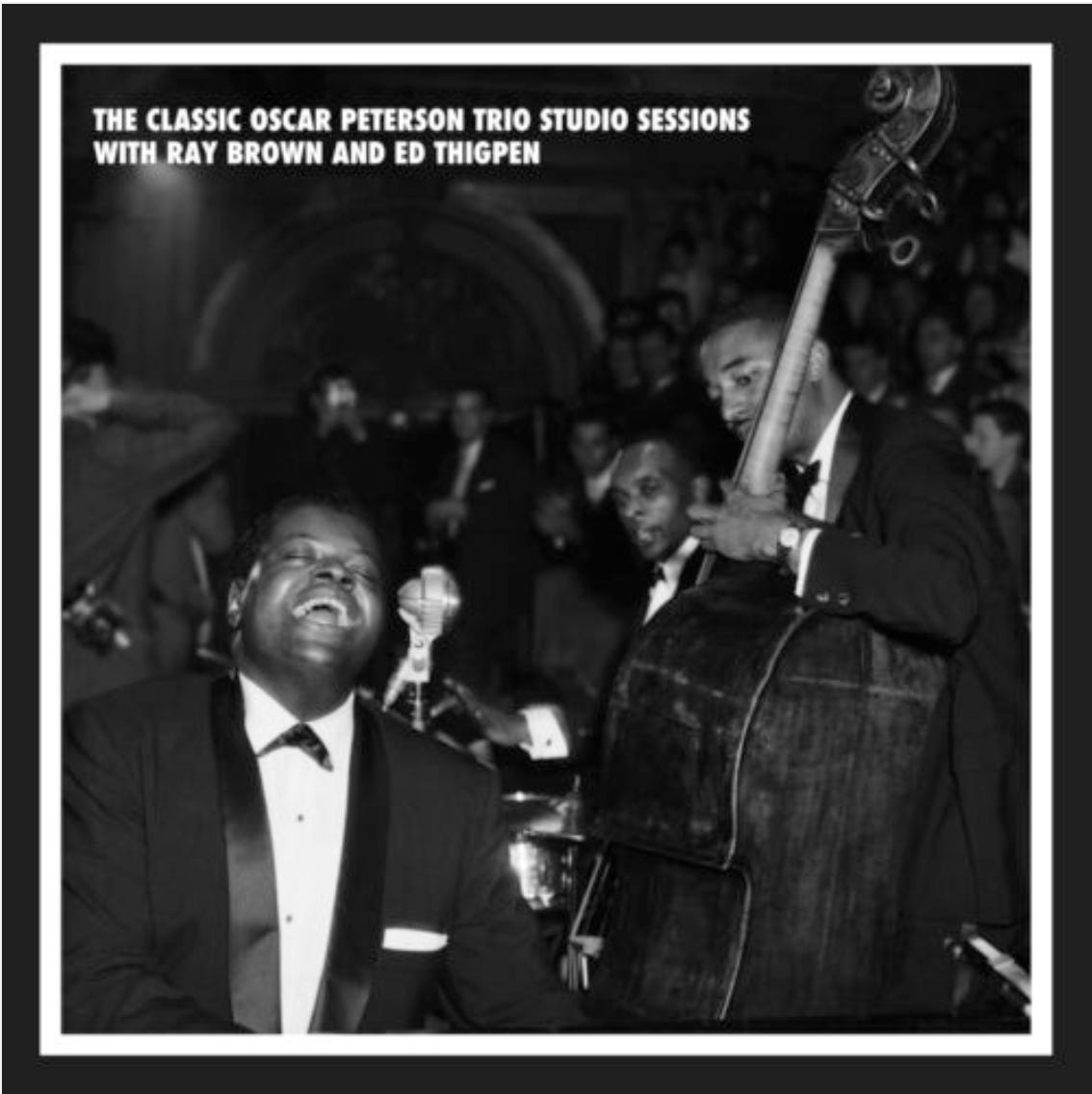
Now Mosaic has released The Classic Oscar Peterson Trio Studio Sessions, an eight-CD set featuring 125 tracks by Peterson, Brown and Thigpen. The material here appeared on the Verve, Limelight and Germany’s MPS labels, spanning from 1959 to 1965.
Newly remastered from original source tapes, the box corrals 14 LPs: A Jazz Portrait of Frank Sinatra, The Jazz Soul of Oscar Peterson, Porgy and Bess, Fiorello!, West Side Story, Affinity, Night Train, The Oscar Peterson Trio Plays, Canadiana Suite, We Get Requests, I/We Had a Ball, Action, The Lost Tapes and The Greatest Name in Jazz. Material pulled from three CDs are Night Train, Collectors’ Disc and Exclusively for My Friends.
This is the Oscar PetersonTrio at its peak, during the years when jazz at this level was universally respected and viewed nationally as fine art. This trio regularly sold out on tours and concerts, and Peterson became a household name as his records sold well, largely because buyers knew they were going to get accomplished playing and interpretations.
On a personal level, what’s glorious about this box is it unites all of the albums I bought as a kid and treasured and then sold off years later in the shift to CDs and then downsizing my analog gear. Best of all, the Peterson Trio on the box sounds better than ever. Why? Here’s Mosaic’s explanation:
“Due to dramatic improvements in analog-to-digital converters and our mastering process, we believe this set will be viewed as the most sonically faithful presentation of Peterson’s extraordinary musical output of the late 1950s and early 1960s. Our goal was to highlight the fine details, beauty, and unique sound inherent in his extraordinary output. This mastering process utilized hi-res 24-bit/192 kHz transfers from the original analog master tapes. The only exception is the MPS recordings, The Lost Tapes where the analog tapes were never found.”
What was left off this box were the nine American songbook composer albums recorded in the summer of 1959. Which, for me, is a sigh of relief, since those should be handled as a separate set rather than dramatically inflating the number of tracks and the price of this box. And frankly, I like this material better than the same old same old songs.
So why was the music produced by this trio special? That’s a tough call, since the Oscar Peterson Duo of 1950 and ‘51, and the trios and quartet that recorded subsequently on the Clef label in the 1950s were hardly chopped liver. The same goes for the trios of the 1970s and beyond. This trio featured Peterson with an especially sparkling dance quality thanks to his lighter touch on the keyboard and a commanding attack that didn’t go overboard.. As with most things classic, the seductions comes with knowing when the experience is just enough.
Most of all, Brown and Thigpen were one of the tightest bassist-drummer duos in the business, providing Peterson with impeccable time and a conversational backdrop. Brown was tasteful and solid straight-ahead bassist, and listening to his contrapuntal lines as Peterson plays is a joy in and of itself. Thigpen was equally juicy, keeping the tempos and execution breezy and light—but with a subtle element of intensity and drama. He played brushes so well you didn't miss the drumsticks.
For those who grew into jazz in the late 1960s and early ‘70s, listening to this Mosaic box will be like reconnecting with old friends. That was true for me of the Frank Sinatra album, West Side Story, We Get Requests and tracks like Shiny Stockings, Satin Doll, This Could Be the Start of Something Big, People, A Foggy Day, L’il Darlin, The Girl From Ipanema, Coney Island U.S.A. and so many others.
Listening over the weekend, I still remember dragging my thumb nail through the Peterson records’ taut cellophane at the opening of the album covers to liberate the LPs. My initial hope was that the record wasn’t warped, which would create a “wow” distortion in the sound. The excitement of these records was the expectation that they would be great. Every song Peterson took on was turned into gold.
What I especially love about this box is that all of the tracks are studio recordings. This trio tended to play a few ticks too fast in concert, largely a result of Peterson kicking off songs in a semi-sprint. In the studio, they were more relaxed and in a sensual zone.
I do hope Mosaic eventually gets around to releasing The Classic Oscar Peterson MPS Studio Sessions 1968-1971. I’d love to hear Girl Talk, Motions and Emotions, Tristeza on Piano, In Tune and the others remastered.
Bob Blumenthal’s liner notes are superb, and the 12-inch, 20-page booklet is loaded with exciting images.
To buy The Classic Oscar Peterson Trio Studio Sessions (Mosaic), go here.
From the box, here’s Shiny Stockings…
Here’s Satin Doll…
And here’s My One and Only Love…
Bonus: Here’s the trio in Holland in 1965 playing Maria…
Oscar's solo on "Satin Doll" is almost entirely “locked hands” (i.e., 4-way close, double lead).
This is a widely-used jazz piano technique that goes back to the 1940s from Milt Buckner, George Shearing, and others. It's also a basic saxophone-section voicing and a George Shearing Quintet (with piano, vibes, and guitar) mainstay.
Here's a transcription of a Bill Evans solo that uses that same technique:
https://www.youtube.com/watch?v=SkjabWb9elM
Bill Evans, p; Paul Chambers, b; Philly Joe Jones, d. January 19, 1959.
Compare and contrast.
If I may, here is a clip I’ve been watching every now and then for years. Oscar Peterson with two bass giants: Ray Brown and Niels-Henning Ørsted Pedersen.
At the Montreux Jazz Festival in 1977... "You Look Good To Me". 🎹🎶
https://youtu.be/3D5k1UdjGhI?is=sZGF6U8AEmar-dCV