

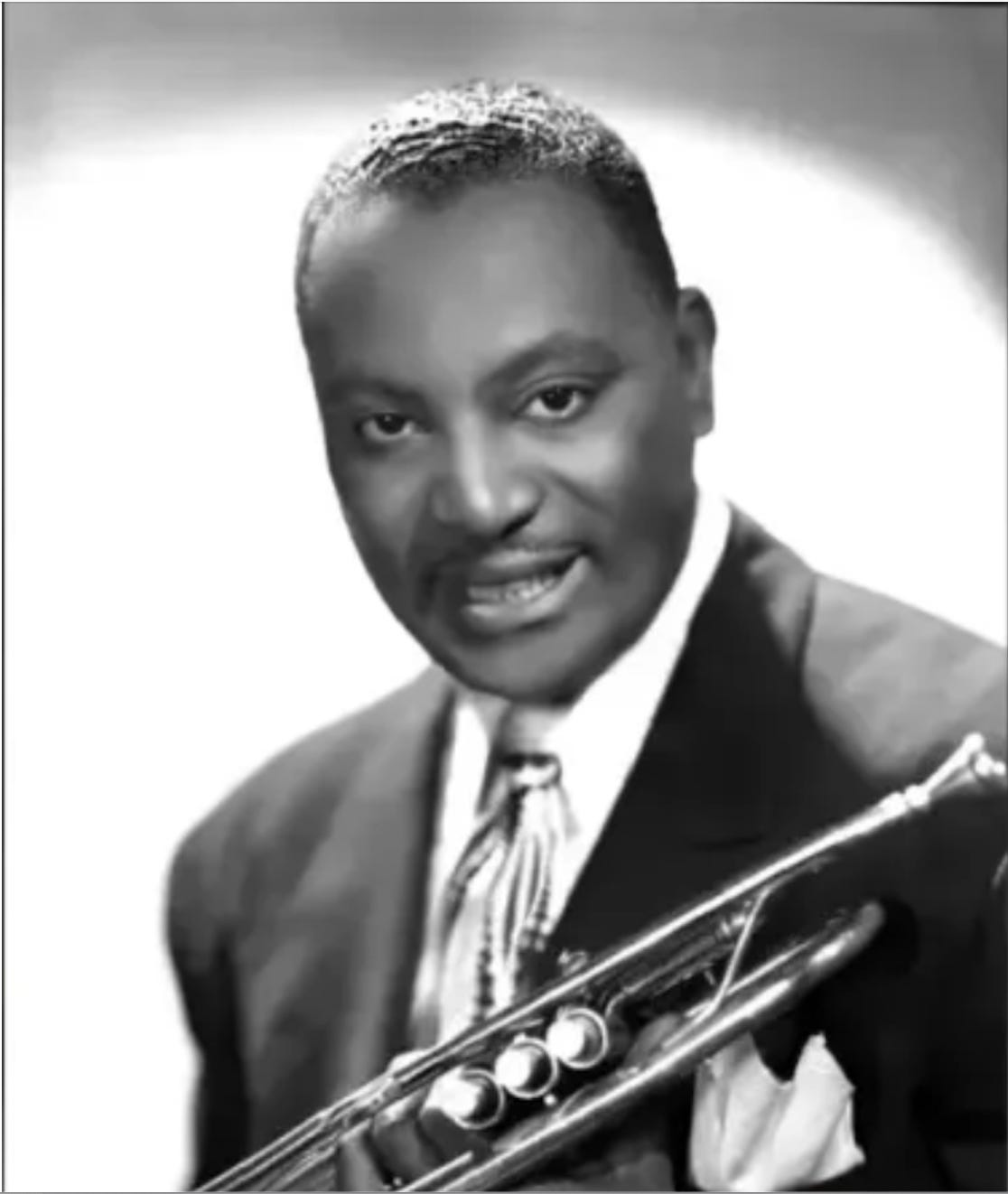
Throughout the 20th century, jazz never ran short of superb trumpeters. Miraculously, each of the greats had his own identifiable musical personality and style. In the case of Cootie Williams, his approach on the horn was most influenced by the more than 10 years he spent in Duke Ellington’s orchestra between 1929 and 1940. [Publicity still above of Cootie Williams]
He favored the “jungle style” of trumpet playing popular in Ellington’s famed Jungle Band of the late 1920s and early 1930s. Instruments were highly expressive, growling in some cases, while trumpets and trombones often used plunger mutes to create a wilder, roaring touch.
In 1940, Ellington composed and recorded Concerto for Cootie to showcase Williams’s plunger-muted, “growling” trumpet. The song highlights Williams’s evocative colorations. When lyrics were added later, the song was re-titled Do Nothing Till You Hear from Me.
Cootie began leading recording sessions while still with Ellington, in 1937, using members of Duke’s band. In 1940, Williams left Ellington for Goodman, and the following year he left Goodman to start his own orchestra.
Among those who played in Cootie’s band in the 1940s before moving on to become major jazz figures were Eddie “Cleanhead” Vinson, George Treadwell, Eddie “Lockjaw” Davis, Bud Powell, Pearl Bailey, Lammar Wright, Sam “the Man” Taylor, Charlie Parker and Ella Fitzgerald.
Charles Melvin Williams was born on July 10, 1911 in Mobile, Ala. “Cootie” was a childhood nickname. His first recordings were made with James P. Johnson in 1928. After his long stay with Ellington, his jump to Goodman became a big get for the clarinetist.
In the 1950s, with the big bands on the decline, he folded his orchestra and played rhythm and blues in ensembles. With the arrival of the 12-inch LP mid-decade, Williams began to record again as a legacy artist, often teamed with cornetist Rex Stewart. In 1962, he rejoined Ellington and remained with the band until 1974.
Cootie Williams died in New York in 1985, at the age of 74, from a kidney ailment.
Let’s dive into the music:
Here’s Williams leading bands from 1941 to 1944…
Here’s Williams leading bands in 1945 and 1946…
Now let’s jump to the late 1950s and three great Cootie Williams albums:
Here’s Cootie Williams and Rex Stewart on The Big Challenge (1957). Williams is on trumpet while Stewart is on cornet. Williams’s trumpet has a bright, piercing sound, while Stewart’s cornet offers a warmer, mellower tone.
Here’s Williams’s album Cootie Williams in Hi Fi (1958), arranged by Bill Stegmeyer. It’s the full album, one track at a time…
Here’s Williams playing It Ain’t Necessarily So from Porgy & Bess Revisited…
Bonus: Here’s Williams performing during the Super Bowl IX Halftime Show in 1975, with the Duke Ellington band led by his son, Mercer Ellington. Move the time bar to 5:25…
Steve Bowie recently published a very good bio, "Concerto for Cootie". Highly recommended.
A wonderful memory of Cootie Williams. Thanks, Marc.
There's a fantastic concert from November 8, 1969, at the Berlin Jazz Days, featuring the Duke Ellington Orchestra. Cootie Williams has a solo right from the first song, "Take the A Train." There are excerpts of the concert on YouTube, but the technical quality isn't great. However, the complete concert isn't available in its entirety, unless I'm mistaken. Some time ago, the French-German cultural television channel ARTE added this concert to its media library. The picture and sound quality is perfect, and the concert itself is excellent. This concert, along with many others from the Berlin Jazz Days, was recorded by the then-public broadcaster SFB for later television broadcast.
Here's the link to the concert, but I don't know if it's accessible in the US. If not, try using a VPN connection. It's worth it.
https://www.arte.tv/de/videos/128110-001-A/duke-ellington-orchestra/
And here is a selection of some other great concerts from the Berlin Jazz Days.
https://www.arte.tv/de/videos/RC-027322/berliner-jazztage/