

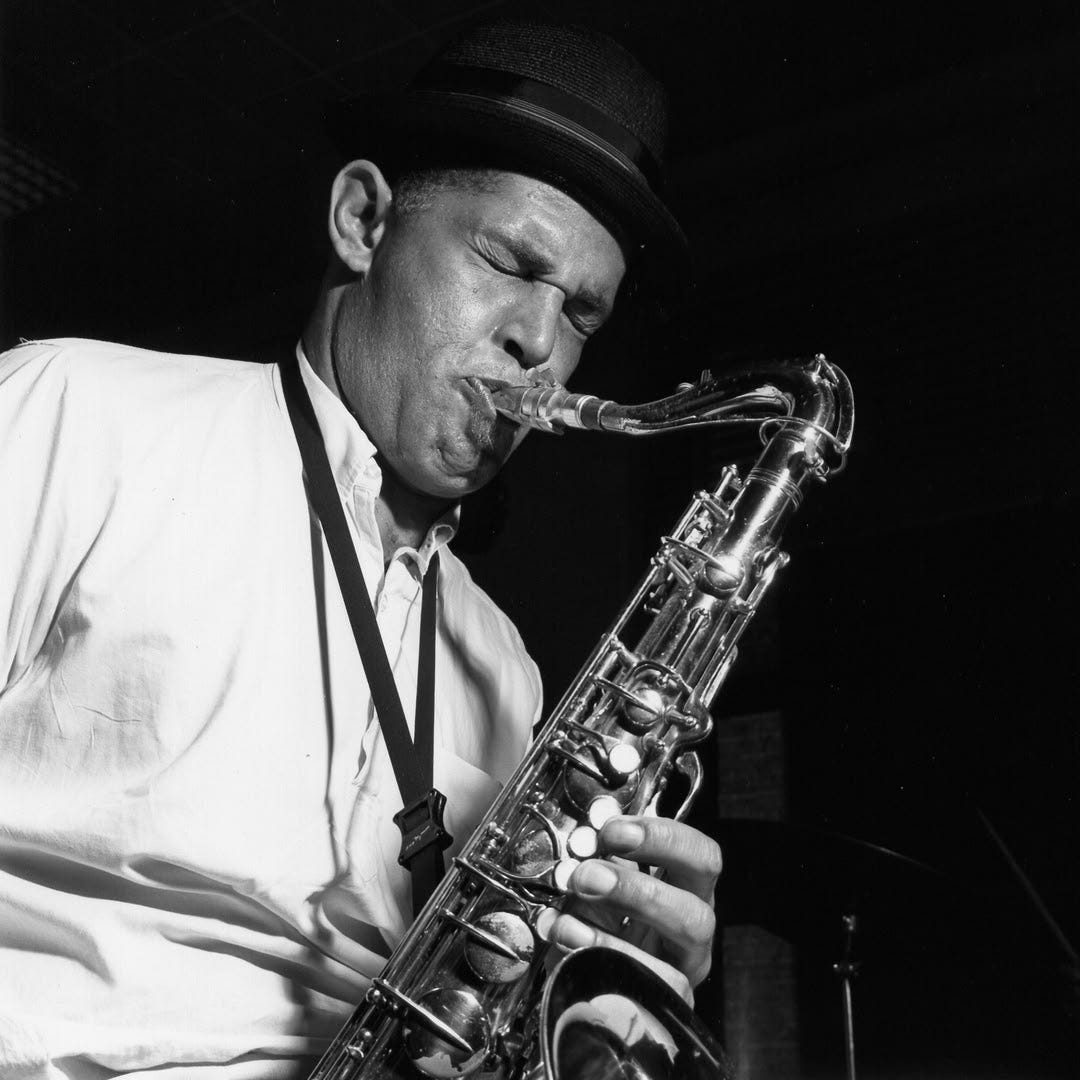
In the late 1950s, Jack Gelber wrote a play called The Connection, which dramatized the desperate enticement of narcotics and the perils of addiction. The play was produced at New York’s Living Theatre, on the second floor of the former Hecht’s department store on Sixth Ave. at 14th St. [Photo above of Dexter Gordon in the early 1960s by Francis Wolff © Blue Note Records]
Initially, jazz musicians were just going to improvise on stage to provide incidental music for the actors. But when pianist Freddie Redd finished the score, he convinced Gelber to use it in the production and to feature himself, alto saxophonist Jackie McLean, bassist Michael Mattos and drummer Larry Ritchie during the play’s run.
Its raw realism and incorporation of live jazz received praise from the New York press, and so Gelber launched a West Coast production in 1961. For the Los Angeles version, Dexter Gordon composed music and performed.
While there was no official soundtrack recorded for the West Coast production, Gordon recorded three of the songs on his second Blue Note LP, Deter Calling…, recorded in May 1961 and released in January 1962. It was the Blue Note followup to his groundbreaking Doin’ Allright.
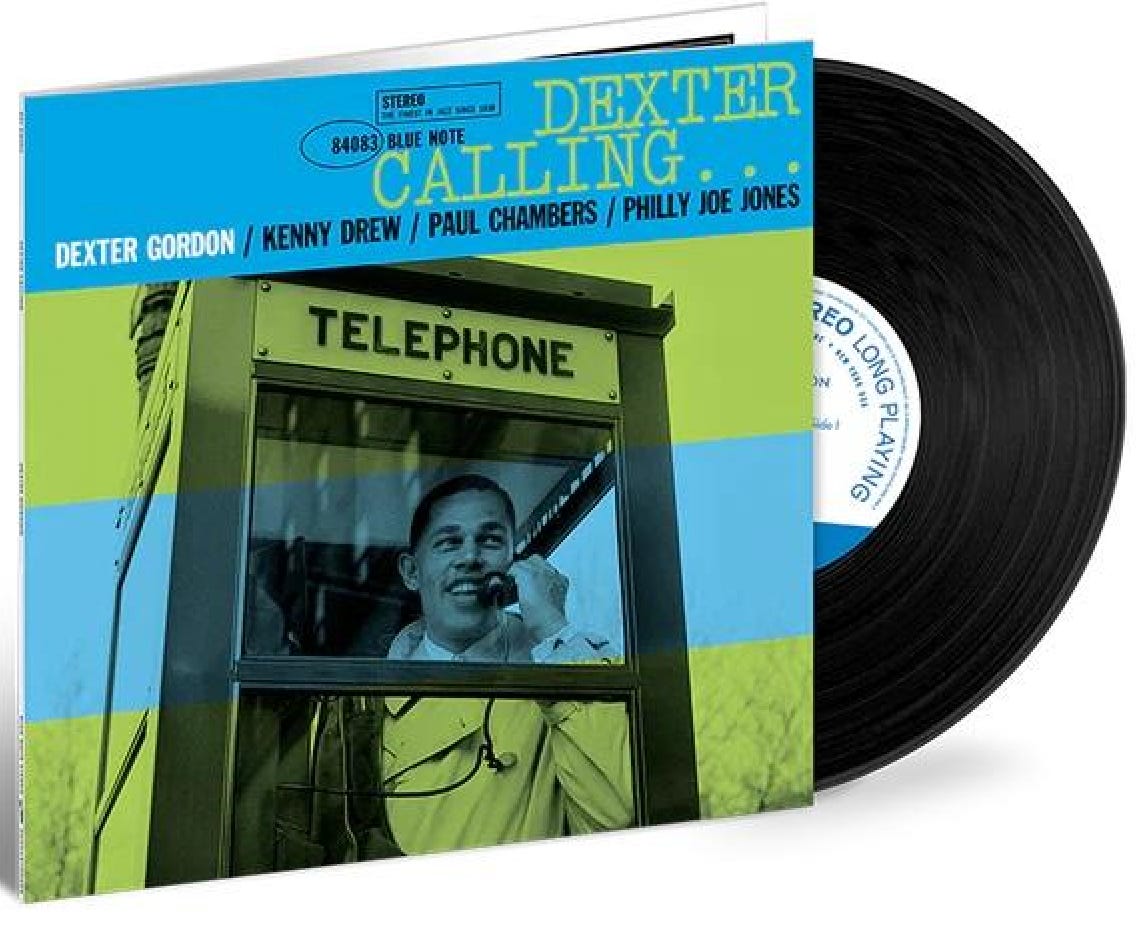
Now, Blue Note’s Tone Poet series has released the album on a 180-gram vinyl LP with mastering by Kevin Gray. All of the players—Dexter Gordon (ts), Kenny Drew (p), Paul Chambers (b) and Philly Joe Jones (d)—are given a chance to solo, and the results are beautiful.
The tracks:
Soul Sister (Dexter Gordon)
Modal Mood (Kenny Drew)
I Want More (Dexter Gordon)
The End of a Love Affair (Edward Redding)
Clear the Dex (Kenny Drew)
Ernie’s Tune (Dexter Gordon)
Smile (Charlie Chaplin)
Soul Sister is a walking gospel blues (Gordon’s answer to Freddie Redd’s Sister Salvation), with solos by Gordon, Drew and Chambers, that opens and closes in waltz time; Modal Mood picks up the pace with a superb, brisk solo by a wailing Gordon, and close-out turns by Drew and Jones; Gordon’s I Want More (an addict’s lament) is a fast-paced, billowy and lyrical track, providing a taste of Gordon’s bop ferocity plus a Drew solo.
On side 2, End of a Love Affair opens with Gordon laying down down the standard’s melody in the lower register. He then moves up to the middle for his bop solo and a sterling turn by Drew; Clear the Dex is a swinging bop burner, featuring Gordon’s seamless ribbons of lines and Chambers playing with a bow, followed by Drew. Dig how Jones hits the snare throughout.
The album’s high point is Gordon’s mournful ballad, Ernie’s Tune, written for the Ernie character in The Connection. Where Redd saw optimism for Ernie, with his flag-waver Music Forever, Gordon doesn’t have high hopes, delivering a solo akin to a memorial. And finally, there’s a short take on Chaplin’s Smile, which Gordon wisely plays at a brisk pace, avoiding the sticky sentimentality of most versions.
The big difference between Freddie Redd’s and Dexter Gordon’s moods for The Connection is that Redd avoided heroin whereas Gordon had been an addict. His addiction began in the late 1940s, and he spent critical periods in the 1950s imprisoned. He was incarcerated from 1953 to 1955, and again in the late 1950s. As a result, his pieces have the sound of experience while Redd’s has enormous hope. Both are stunning.
By the fall of 1962, Gordon had relocated to Paris and then Copenhagen, where he began a new life and career. He kicked his habit in 1960. Though he visited the U.S. periodically, he didn’t move back until 1976.
Dexter Gordon died in 1990 at age 67 of kidney failure and smoking-related cancer of the larynx.
To buy, go here.
To read my interview with Maxine Gordon, Dexter’s wife, go here.
Here’s Dexter Gordon’s Dexter Calling…, track by track…
Another education from Marc. Hard to keep up. His kind efforts are all worth and require serious attention.
Dexter’s widow, Maxine, published a biography of him a few years ago. The events of the 1950s were so painful for Dexter that he wouldn’t talk about it. That period is unaccounted for in the book. Stunning how the dearth of recordings from the ‘50s was supplanted by the Blue Note treasure trove of the ‘60s. All were instant classics.