

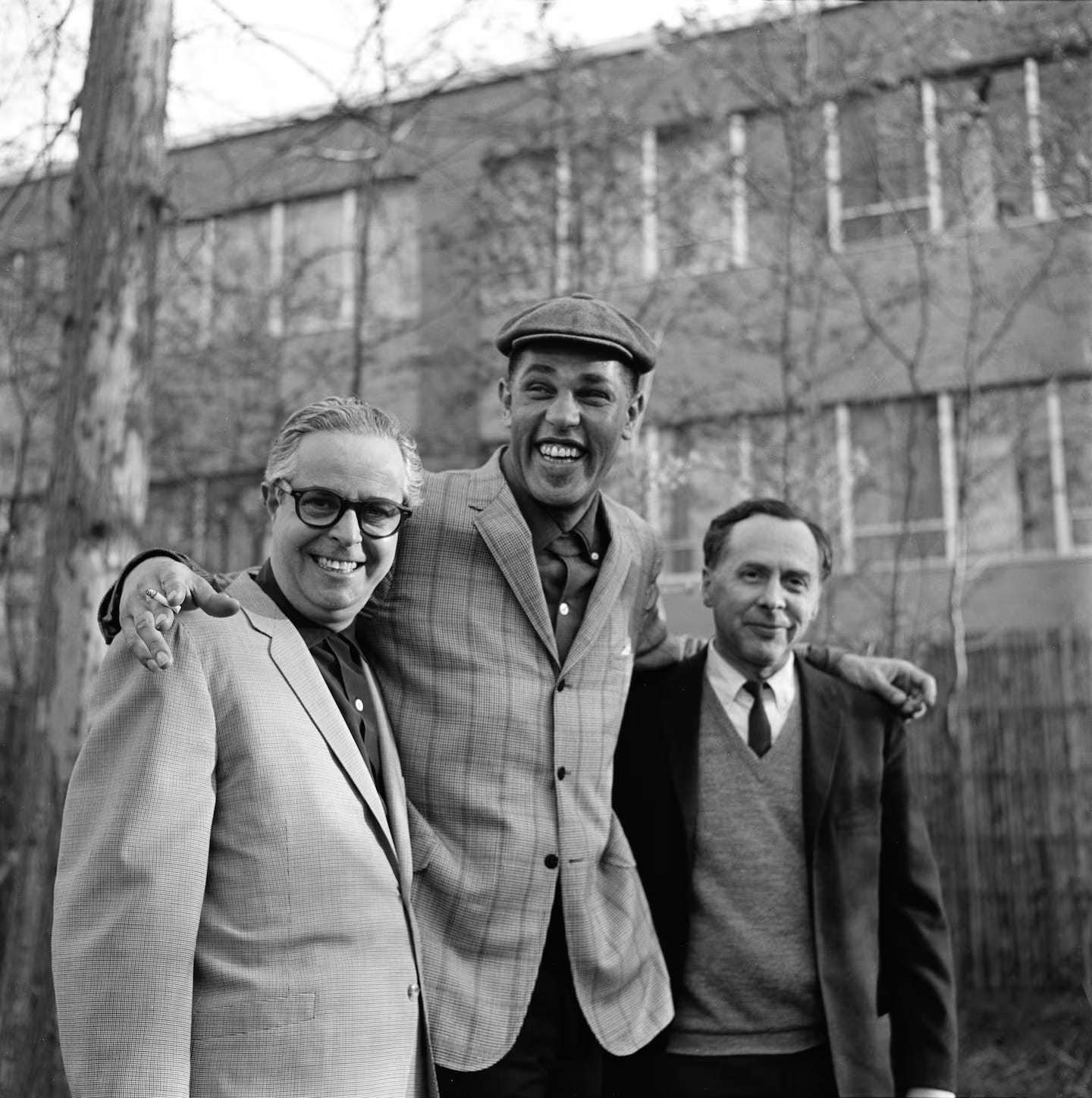
Blue Note Records changed jazz’s direction not once but multiple times. When the label was launched in New York in 1939 by Alfred Lion and Max Margulis, Blue Note was first to treat hot jazz, boogie-woogie pianists and soprano saxophonist Sidney Bechet with artistic seriousness. [Photo above, from left, Alfred Lion, Dexter Gordon and Francis Wolff by Rudy Van Gelder]
From the start, the label established a high bar for the treatment of exceptional jazz musicians, a standard of respect that put the independent company out in front and created good will with jazz musicians.
Blue Note then recorded exceptional bebop musicians early, in the late 1940s. The list includes Thelonious Monk, Miles Davis, Bud Powell, Tadd Dameron and Fats Navarro, before they were discovered by major record companies.
When Lion’s childhood friend Francis Wolff arrived in New York from Germany in 1939, he not only joined the company and ran the business side but he also revolutionized album-cover design starting in the early 1950s. A photographer, Wolff took dramatic images of the artists in the studio. This move not only helped Blue Note LPs stand out but fleshed out jazz’s cool, nocturnal mystique. The images also turned covers into jazz promotional vehicles that hooked and intrigued record buyers.
By linking up with recording engineer Rudy Van Gelder at the dawn of the 10-inch LP era in the early 1950s, Blue Note was provided with cutting-edge technology known then as magnetic tape. The label also benefited from Van Gelder’s sonic acumen, which gave the label’s LPs a warm and dimensional sound.
In the early 1950s, Blue Note helped launch hard bop, starting with albums such as A Night at Birdland Vols. 1-3, in 1954. The label enabled the new, aggressive style tp develop and flourish by recording a long list of pioneering artists, including Art Blakey, Horace Silver, Hank Mobley, Lee Morgan, Donald Byrd and Freddie Hubbard.
In the 1960s, Blue Note merged hard bop with Latin boogaloo and bossa nova, giving rise to a new style of funky jazz that is still being sampled by younger artists. It also helped modal jazz to develop, issuing albums by Wayne Shorter, McCoy Tyner, Bobby Hutcherson and others.
And finally. the label was at the forefront of avant-garde jazz by recording Eric Dolphy, Andrew Hill, Cecil Taylor, Sam Rivers and other musicians who might not have been able to find a label willing to record them or find an audience.
There are two major documentaries on the label—Blue Note Records: Beyond the Notes (2018), directed by Sophie Huber; and Blue Note: A Story of Modern Jazz (1997), directed by Julian Benedikt and Andreas Morell. The latter documentary provided many interesting historical insights and provided rare on-camera appearances by artists such as Gil Mellé.
Here’s the full Blue Note: A Story of Modern Jazz…
Thanks, Marc!
I have only seen the Sophie Huber doco (2X)
Can't wait (I have almost every BN title re-released on CD, 90% of which are Nihon remasters)
File me under 'F', for fanatic!