

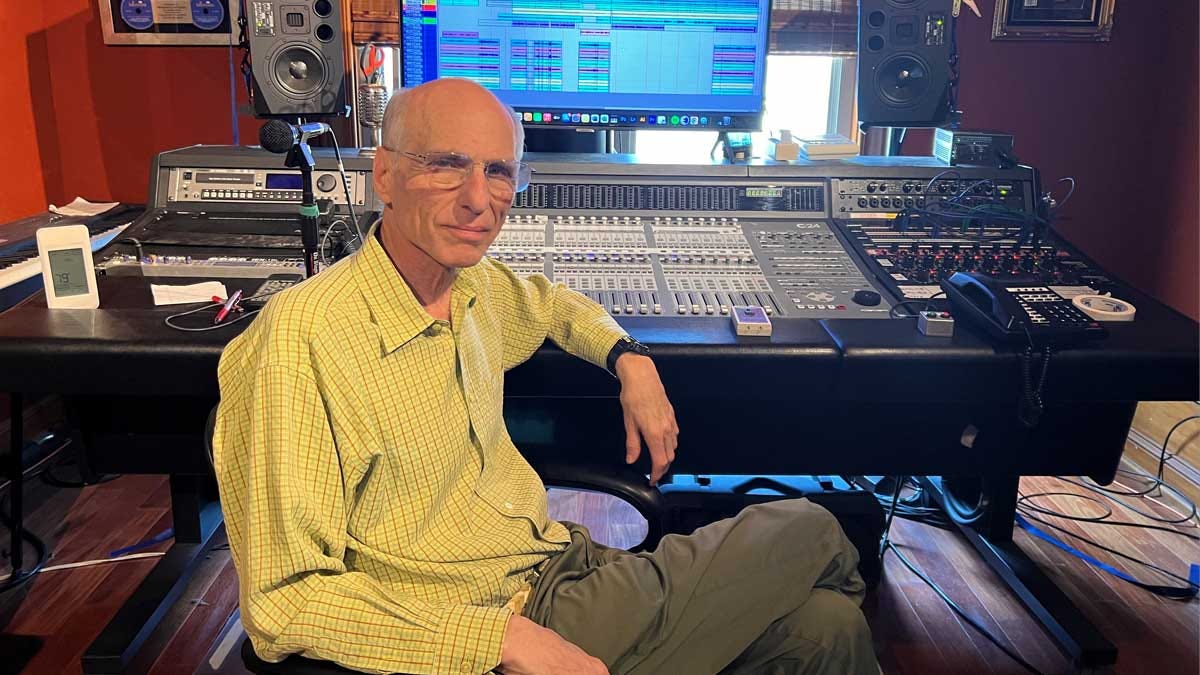
Resonance Records was founded by George Klabin in 2007, the year I launched JazzWax. He is co-president of the non-profit label with producer Zev Feldman. Resonance is responsible for many high-quality audio releases, most notably a long series of previously unreleased Bill Evans Trio albums. [Photo above of George Klabin]
George has a fascinating background that may not be known to many fans of the label. For example, he’s fortunate to be here. His mother escaped Austria in 1939 following the Nazi occupation in 1938 and resettled in Brazil, where she had relatives. That’s where she met George’s father.
George’s exposure to music and the gift of a Victrola at an early age led to his life-long fascination with recording technology, jazz and the bossa nova.
Here’s my email interview with George…
JazzWax: George, tell me about your early life.
George Klabin: My grandparents on my father’s side met and lived in Lithuania. They left in the late 1890s and sailed for São Paulo, Brazil, to escape the pogroms. One of their children, Mauricio, had emigrated to São Paulo several years earlier and wrote them about the many opportunities to create businesses in that country.
JW: Once in São Paulo, what did the family do?
GK: They eventually started a paper factory that opened around 1899. It was called Klabin Brothers and is today the second largest paper manufacturer in South America.
JW: And your father?
GK: My father, Samuel, was born in São Paulo in 1910. Our family name was originally Lafer, but some family members had changed it to Klabin in Lithuania. It was the name of a non-Jewish man who had died. The family thought they could evade the Czar of Lithuania’s oppression by buying Klabin’s land and taking his name. Unfortunately, that didn’t stop the Czar’s persecution.
JW: What about your mother?
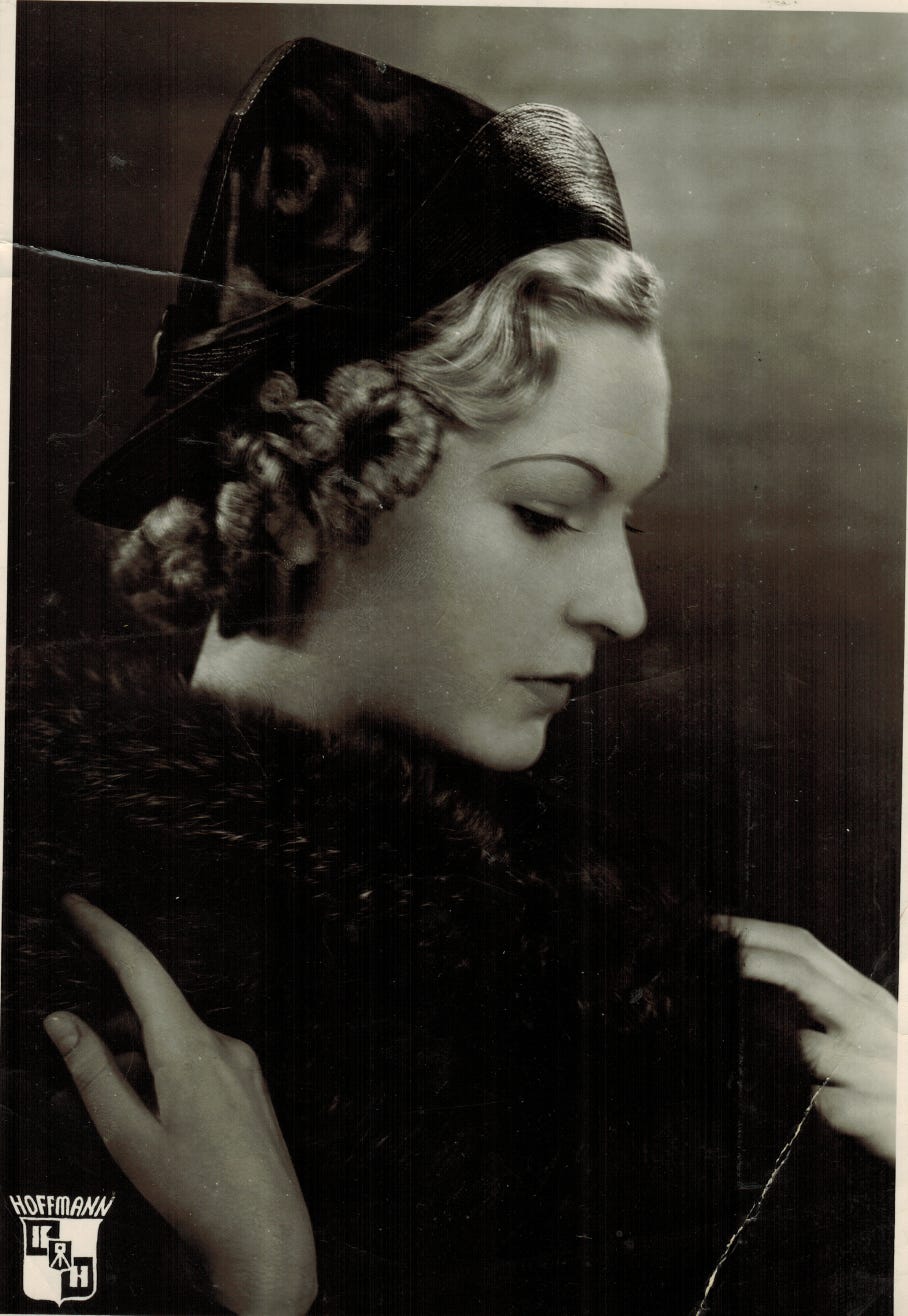
GK: My Austrian mother, Gertrude “Trudy” Gleich, and her mother escaped the Nazis when she was 20 years old. Fortunately, she let go of her budding career as a movie actress ingenue, and they sailed to Brazil in 1939, settling in São Paulo. [Photo above of Trudy Gleich at age 18 in Austria, courtesy of George Klabin]
JW: Why Brazil?
GK: Several years earlier, her two older brothers had emigrated to São Paulo. By the time my mom arrived, one of her brothers, Lutz, an engineer, wanted to build a factory to produce precision ball bearings and pistons for the burgeoning Brazilian auto industry. Lutz had met my father at a party, where my father, 30, confided that he was ready to find a wife.
JW: What did Lutz do?
GK: My mother was a very beautiful and well-educated woman. Years later, I saw her in a German-language movie made in 1938. I can’t recall the name, but she had a single line. Lutz thought Sam might like Trudy, but he also had an ulterior motive.
JW: Which was?
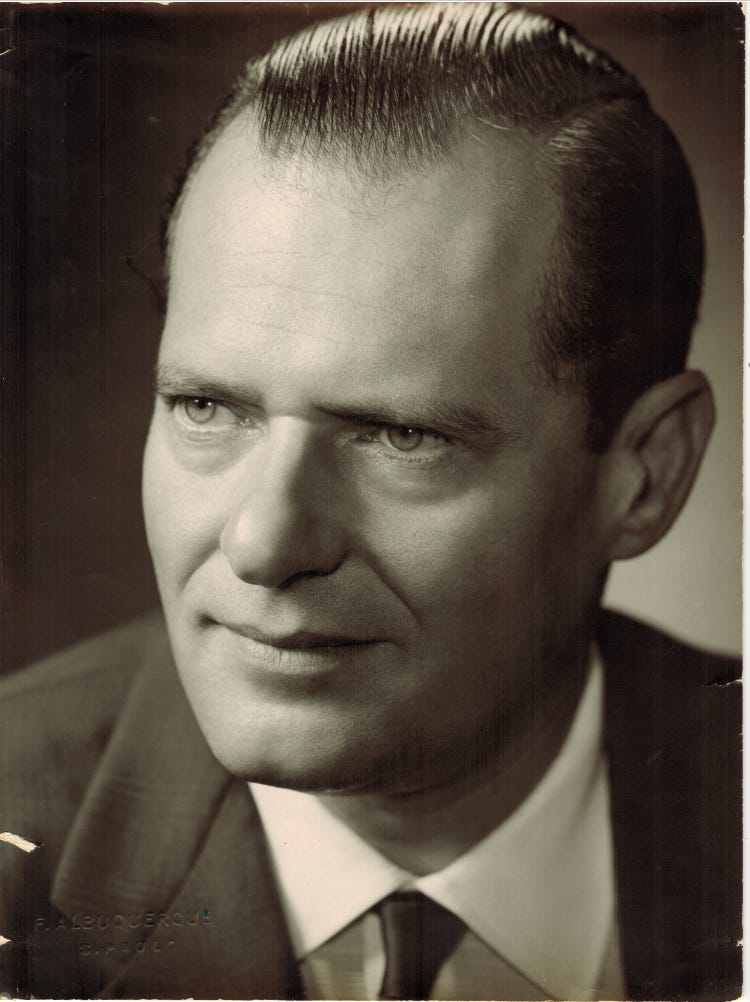
GK: Samuel was wealthy, and Lutz wanted him to invest in his ball-bearing factory. He urged Trudy to meet him, hoping that if he liked her, they might marry. That union would lead to a factory investment. So Lutz took Trudy to meet Samuel, who fell for this beautiful blonde 20-year-old. [Photo above of Samuel Klabin, courtesy of George Klabin]
JW: She was willing?
GK: Trudy really wasn’t interested in marrying someone she barely knew. Lutz convinced her that Samuel was rich and that she would have a much better life with him, with all the money and prestige of the family name. Not having much else to choose from, and living with her mentally unstable mom in a small house in São Paulo with very little money, she agreed. They were married in 1940.
JW: Was it a good match?
GK: My mother was a very cultured, intelligent woman. Dad, on the other hand, loved to work and wasn’t well-versed in the arts or culture. When he was home, he liked to listen to sports on the radio and read newspapers.
JW: Did they remain a happy couple?
GK: In São Paulo, it was customary for wealthy men to keep an apartment for trysts. Since they never had affairs, occasional sex with paid prostitutes was acceptable in their circles. Apparently, my mother found out about the arrangement and a few years later decided on a trial separation. In 1943, she left for Manhattan and stayed at the Chelsea Hotel on 23rd Street, where painters, writers and musicians had rooms or suites. My mother had visited New York as a teenager and loved it. While at the hotel she met the writer Antoine de Saint-Exupéry, who wrote the famous “Little Prince” story, and Edgar Lee Masters, who wrote “The Spoon River Anthology” poems.
JW: So your mom remained in the city?
GK: Mom soon started painting and adored New York’s culture. She didn’t want to return to Brazil. My father, however, realized what he was losing and traveled to Manhattan to convince her to repair the marriage by having a child. She reluctantly agreed and returned to Brazil. In 1945 she became pregnant with me.
JW: Where were you born?
GK: I was born on April 3, 1946 in Manhattan, because the best hospital in São Paulo had a 40% death rate for births. My mom had taken a flight to New York from São Paulo. The flight was aboard a noisy DC-3 prop plane that traveled at about 125 miles an hour. Since there wasn’t any radar for passenger airplanes yet, the plane flew beneath the clouds and landed every evening. Passengers then stayed at a hotel and resumed flying only during the day. The trip took five days.
JW: How did she gain entry to the U.S. given she was pregnant?
GK: Mom told me she sneaked me into the U.S. with a tourist visa. She was already showing a belly, but she wore a heavy mink coat to hide it. When she got to the customs clearance, the polite officer asked if she wanted to remove her coat to be more comfortable because it was rather hot. She said no thanks. Once she cleared customs, she got in a cab.
JW: Where did you live?
GK: She rented an apartment in a building on 59th Street and 7th Avenue. That red-brick building is still there. After eight months, she took me to São Paulo. She tried to make the marriage work, but it lasted only about three more years.
JW: Then she returned again to New York?
GK: Yes. We flew back and she proceeded to file for divorce. She was about 30 at the time. She had received a very nice settlement from Dad and we lived very comfortably. In return, Dad had custody of me every summer. Each June, I few down to São Paulo to stay with him and returned at the end of August, until I was 21. I learned to speak Portuguese fluently.
JW: So you were in Brazil around the time the bossa nova started?
GK: Yes, I was 12 then. I also started hearing bossa nova on Brazilian TV and radio around 1960 or ‘61, when it was becoming widely accepted as a new musical style. I recall a few pianists who played bossa, including Pedrinho Mattar, who was quite famous and had his own musical show on TV. Already a lover of modern jazz, I had a good collection of LPs at my New York home.
JW: What did you think of bossa nova?
GK: I was fascinated by the style. It combined authentic Brazilian rhythms with jazz improvisation. The Tamba Trio and the Zimbo Trio come to mind as major influences on my appreciation. I started to frequent a very large record store in downtown São Paulo called Bruno Blois. The owner named it after himself.
JW: Fun?
GK: Of course! At the time the store allowed you to select LPs and play them in special listening booths. I hung out there for hours and always purchased a few jazz and bossa nova LPs released by local Brazilian labels, featuring Brazilian musicians. I collected for eight years. When bossa nova jazz began to be recorded by American labels, I was able to buy some in New York.
JW: Where did you go to school in the U.S.?
GK: The Taft School, a private Connecticut boarding school. I graduated third in my class out of 97 kids. By then, I had started to play piano by ear and learned a few blues and other easy-to-play tunes that I practiced daily in the music department’s basement, where they had piano practice rooms. I also found friends who enjoyed the arts.
JW: What initially interested you in jazz?
GK: My first love was boogie-woogie piano. I learned a few licks to play in that style. Later, as my sophistication level grew, I listened to Erroll Garner, then Oscar Peterson and finally Bill Evans in the mid-1960s. By age 6, I was fascinated by music technology after my father gave me a windup portable Victrola when he upgraded to LPs. I also was given a bunch of 78s. The Victrola fascinated me.
JW: And how did you become fond of recording music?
GK: When the first home tape recorders were sold in the late 1950s, I was given one as a present and played around with it, recording myself as a jazz DJ and making up my own shows. By the time I was in high school, I booked jazz pianist Howard Reynolds and his trio for a concert at the Taft auditorium. I recorded it and eventually had the tape transferred to acetate. That was my first so-called record release on my Kool Jazz label.
JW: Still have it?
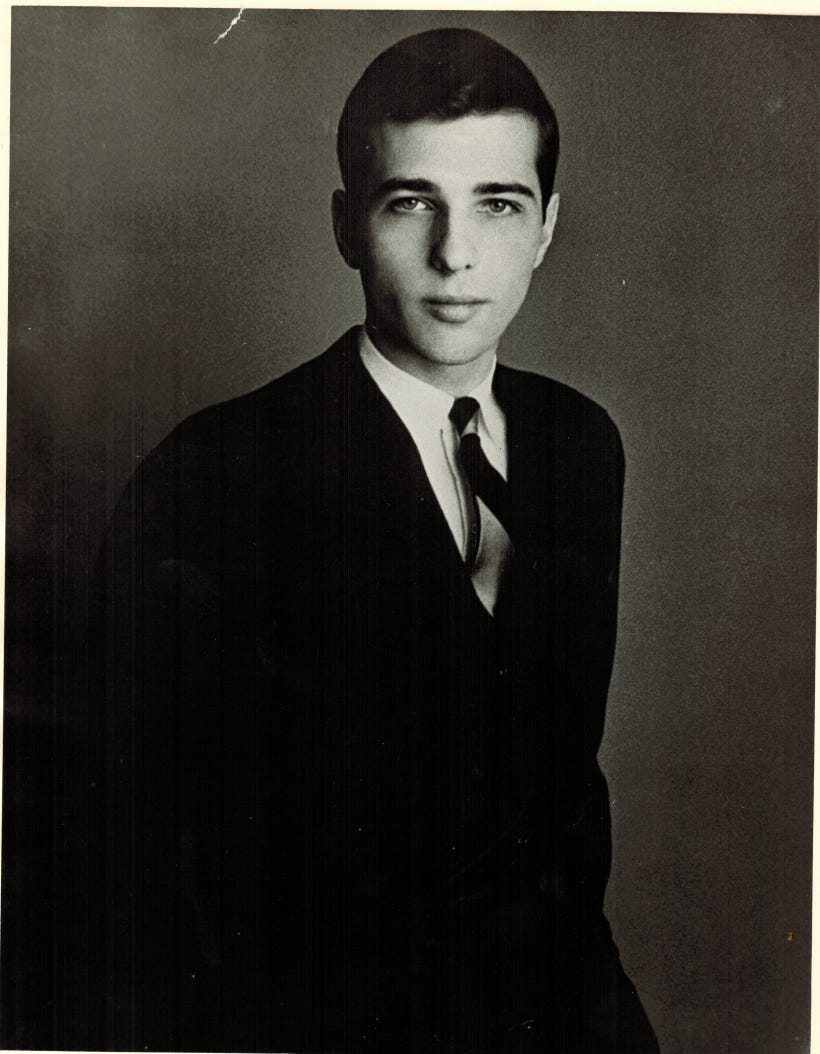
GK: I do. I have the acetate and my liner notes. When I got to Columbia University in 1964, I became head of the jazz radio department and had my own three-hour show, “Jazz Til Midnight,” every Sunday night on WKCR-FM, the university’s station. [Photo above of George Klabin at age 20, courtesy of George Klabin]
JW: When did your recording hobby turn serious?
GK: I started to record live jazz musicians seriously when I had my radio show in 1965. I wanted to present recordings that could only be heard on my show. I started calling musicians and offered a free copy of my recording of them if they allowed me to play it on the air just once. Most readily agreed.
JW: Who was first?
GK: Pianist Roger Kellaway, with Russell George on bass and Dave Bailey on drums. At the time, Roger was with the Clark Terry/Bob Brookmeyer Quintet and also recorded for the Impulse label. When they played The Blues and the Abstract Truth, I used the radio station’s tape recorder and mics but wasn’t totally satisfied with the result.
JW: What did you do then?
GK: I decided to purchase professional equipment and ended up with a 2-track Crown tape deck, an Ampex mixer, six very good German microphones and a pair of Beyer headphones. I could pack up all of this and transport the gear anywhere easily.
JW: What did you do?
GK: I started recording musicians on Sundays at the Wollman Auditorium at Columbia. It has since been torn down and replaced. On stage, they had a gorgeous nine-foot Steinway concert grand that was always tuned. I could sign up to utilize the concert hall stage for recordings. After a while, I got a reputation for doing these free recordings and even had musicians ask me to record them in concert, for which I charged $50 to $100—good money in the mid-1960s. The rent on my apartment was about $400 a month and milk was 25 cents a quart.
JW: Over time, what happened?
GK: I recorded a wide range of jazz greats in the auditorium for my shows. I also taped with permission at venues such as New York’s Village Vanguard and Town Hall.
JW: Who were some of the musicians you taped?
GK: Gary Bartz, Keith Jarrett, Gary Burton, Ran Blake, Freddie Hubbard, Sheila Jordan, the Frank Foster Big Band and Bill Evans. I released our Top of the Gate recording of the Bill Evans Trio on Resonance in 2012. Eventually, in 1966, I taped the opening night of the Thad Jones/Mel Lewis Band at the Vanguard, which I released on Resonance Records in 2016.
JW: Who took you under his or her wing?
GK: I didn’t have any real mentor in my career. I was self-taught. I started Resonance Records in 2007 as a division of Rising Jazz Stars Inc., which had launched a few years earlier to produce live jazz concerts in the Los Angeles area at my studio/performance center. I liked the word “resonance.” Everything that exists has a resonance. It means life, rather than stagnant death. I didn’t want to make a profit on the business, so I filed for non-profit status.
JW: Still involved with radio?
GK: I am. Each week, I produce a 90-minute show called The Heart of Brazil. The shows are posted at our Resonance Records YouTube page. They will remain there for posterity. [To listen, go here and scroll down to “For You,” which allows you to scroll horizontally and see the episodes. To listen to Show #1, go here.
JW: What were your first Resonance releases?
GK: They were CDs released in 2008—one by singer Cathy Rocco called You’re Gonna Hear From Me, and one by pianist Mike Garson called Conversations With My Family. I think of the label as a jazz museum and our recordings as musical versions of important artistic paintings that hang on a wall. We feel we are preserving jazz’s history and the legacy of seminal musicians who played modern jazz. We also record today’s best jazz musicians, such as pianists Tamir Hendelman and Josh Nelson, clarinetist Eddie Daniels and so many others.
JW: A life well lived?
GK: Not bad at all. I’m very lucky my mother made it out of Nazi Germany when she did and that her brothers had left for Brazil years earlier. Otherwise, she never would have met my father.
[Here’s George Klabin’s recording of Bill Evans: Live at Art D’Lugoff’s Top of the Gate on Oct. 23, 1968, with Eddie Gomez on bass and Marty Morell on drums]…
What an inspirational story. There are so many heroes in the story of jazz. It makes me proud to be a fan. Bravo, bravo.
Thank you for this wonderful interview. Messrs. Klabin and Feldman have given us incredible recordings from some of the music's greatest figures in the past several years.