

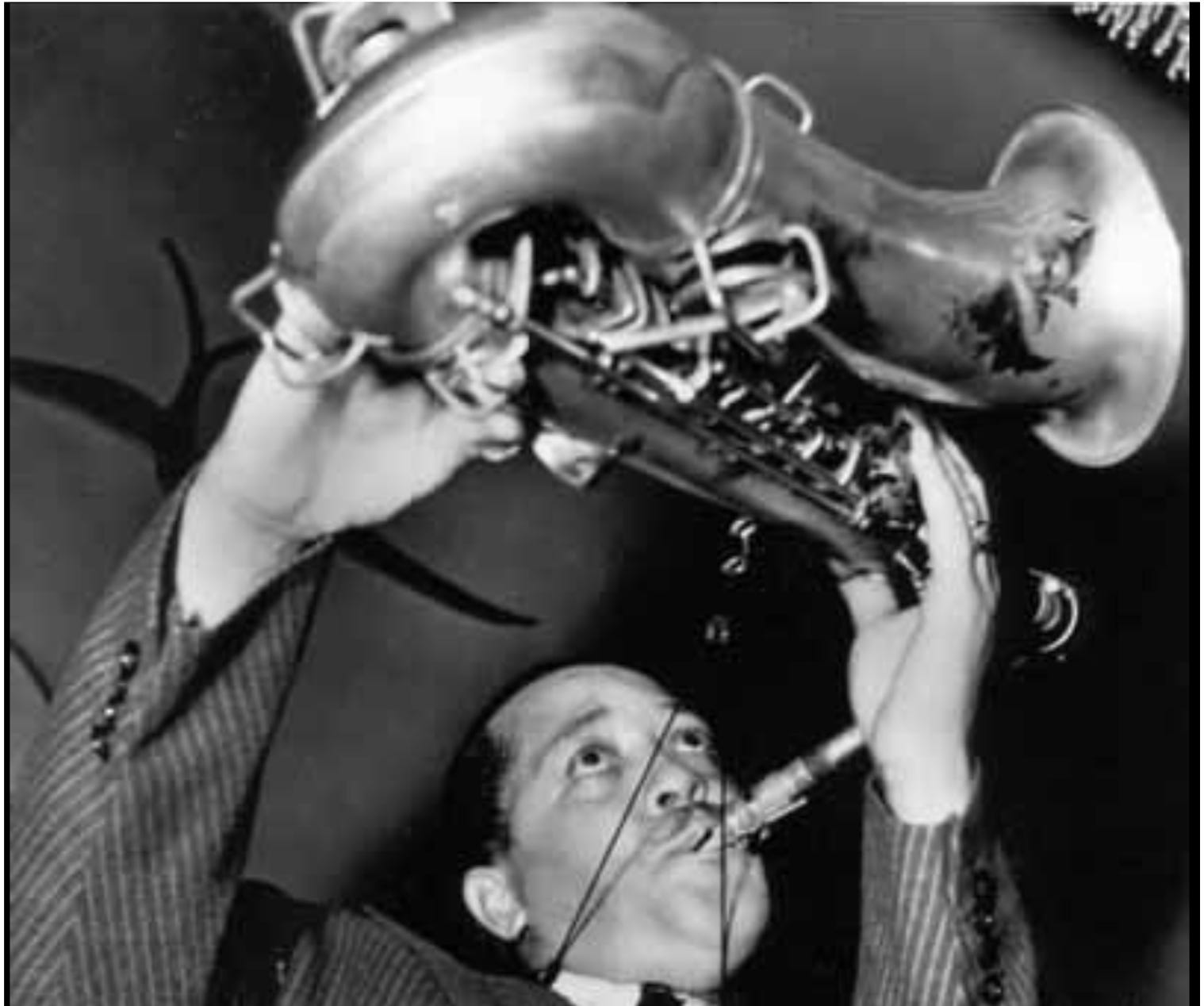
From the start, jazz was about syncopation—the adding of rhythmic emphasis where there wouldn’t normally be one to facilitate an upbeat spirit and dancing. Jazz’s first major movement was ragtime, which started in the 1890s and lasted until around 1910. Early on, it employed syncopation on the piano. Why did ragtime emerge in the 1890s and not earlier or later? [Photo above of Lester Young improvising while holding his tenor saxophone at a 45-degree angle]
We can thank the printing press for that. In the late 1890s, sheet music began to be published on a mass scale, allowing skilled pianists in home parlor and on stage to play the rags. Recording ragtime on wax cylinders began in 1895, with Ernest Hogan’s La Pas Ma La (1895) and Ben R. Harney’s You’ve been a Good Old Wagon (1895).
Here’s La Pas Ma La…
And here’s Ben R. Harney’s You’ve Been a Good Old Wagon (1895)…
By 1899, ragtime—music with a ragged tempo—grew in popularity and peaked with Scott Joplin’s Maple Leaf Rag. Though the famed rag was published in 1899, Joplin wouldn’t record it until 1916…
With the onset of ragtime’s popularity in the late 1890s and the early 1900s, cornetist Buddy Bolden took the ragged syncopation and mixed in the blues and New Orleans parade music, giving each instrument in his ensemble a chance to chime in and harmonize. Here’s Wynton Marsalis explaining Bolden’s invention…
New Orleans pianist Jelly Roll Morton bridged ragtime and jazz improvisation. Here’s Jelly Roll Blues. in 1924…
By 1925, Louis Armstrong and His Hot Five—Kid Ory (tb), Johnny Dodds (cl), Lil Armstrong (p), and Johnny St. Cyr (bj)—took jazz to the next level, standing out as an electrifying cornetist backed by an ensemble that played harmony while he improvised and sang. Here’s Gut Bucket Blues in 1925…
Duke Ellington brought improvisation to an orchestral setting through his sidemen as he developed his growling “jungle” sound, Here’s East St. Louis Toodle-Oo in 1927…
Earl “Fatha” Hines gave jazz improvisation a more cosmopolitan and dramatic sound in Chicago in 1928, on Caution Blues…
Alto saxophonist Jimmy Lunceford smoothed out syncopation and helped invent swing in 1934 with Swingin’ Uptown…
Benny Goodman added polish and artful improvisation with a conversational clarinet in 1935…
Bunny Berigan’s trumpet solo on I Can’t Get Started in 1937 was largely improvised but the structure was worked out in advance…
Lester Young on tenor saxophone and Buck Clayton on trumpet created excitement on their solos for Count Basie, who championed Kansas City swing. Here’s Every Tub in 1938…
Here’s Coleman Hawkins in 1939 improvising on Body and Soul. Though Hawk worked out what he was going to do in advance, his ability to transform the standard into a completely different song using the chord changes was a milestone in jazz improvisation and an inspiration for many jazz musicians who followed…
Here’s guitarist Charlie Christian on Topsy, introducing what would become bop improvisation in 1941 during an after hours jam session at Minton’s Playhouse in Harlem…
Artie Shaw cooled off the clarinet with sterling technique and a lyrical quality that was unmatched. Here’s Frenesi in 1941…
Tomorrow, Part 2 in this series.
Great over view. Got me thinking. I’d add the Chicago World’s Fair of 1893 was as important as sheet music and more important than recording in spreading the word about ragtime as many of the ragtime pianists appeared there and the majority of music in that period was heard live or not at all.
And though Lunceford’s band was top shelf it was the Fletcher Henderson orchestra with Don Redman that smoothed out the New Orleans style by Louis Armstrong giving Redman a copy of Dippermouth Blues which Redman turned into Sugerfoot Stomp, retaining Oliver’s great solo along the way. That was years before Lunceford and helped take the Armstrong vocabulary to the mainstream through Goodman. 2cents, anyway.
A masters degree in this topic, will move on to part 2 for the phd. Marc, you are phenominal. Digging this new venue, some years on your old one, which was top shelf.