

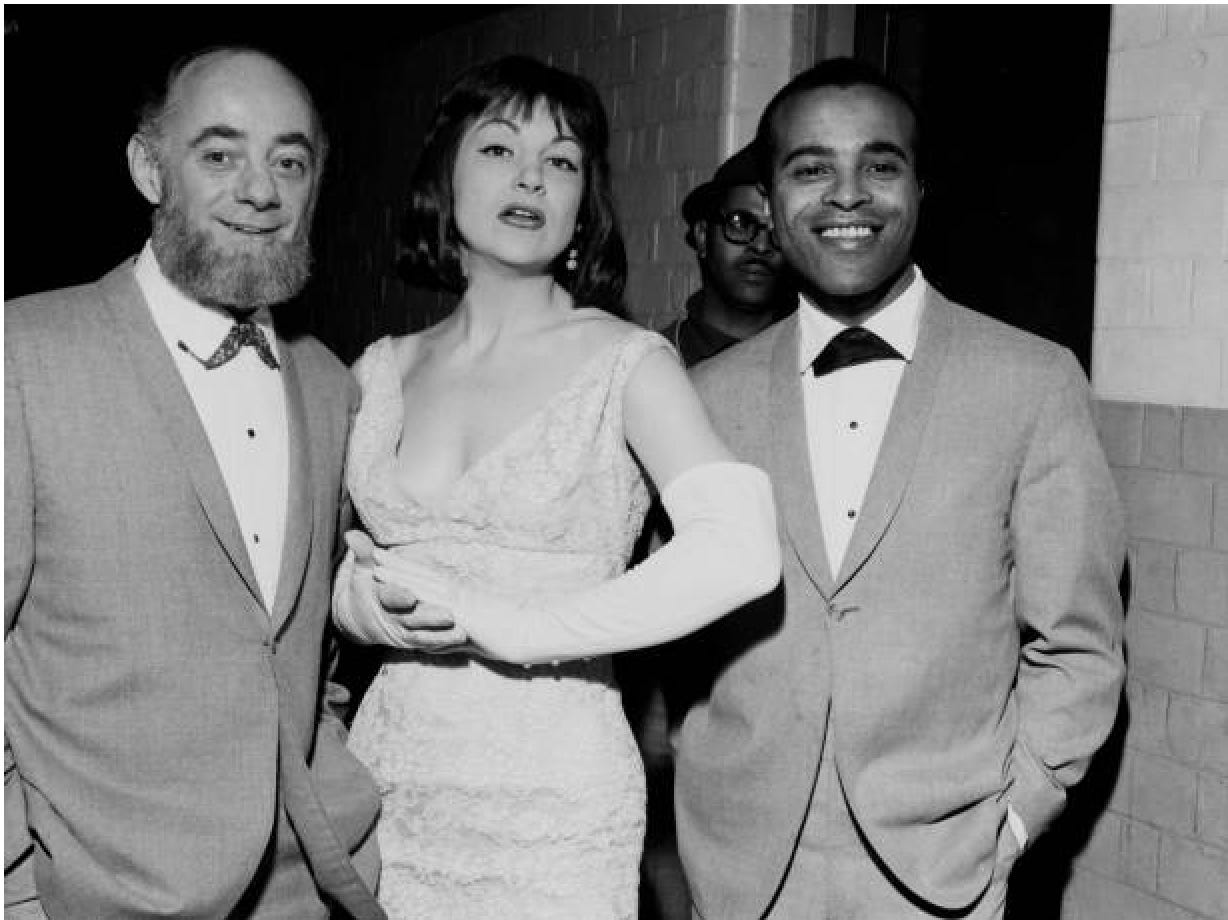
Thank goodness for Europe. Without the intellectual-minded TV producers and movie directors there in the late 1950s and 1960s. we would never have as much film as we do of the artists we love most. [Photo above, from left, Dave Lambert, Annie Ross and Jon Hendricks of Lambert, Hendricks & Ross, courtesy of Getty Images]
And thank goodness for YouTube for providing a home for that footage so the world can view them and be better educated on the genius of jazz artists’ exceptional talents.
In June 1962, the Count Basie Band was on tour in England with singers O.C. Smith, Irene Reed, and Lambert, Hendricks & Ross. Each member of LH&R had pioneered vocalese—substituting vocals with nifty lyrics for jazz instrumental solos.
Collectively, through their commercial success and visibility, LH&R also helped change perceptions of integrated groups during the Civil Rights era.
By June 1962, Ross had left the group and was living in her native London—where she would open the club Annie’s Room in 1964. While Basie was touring in England, she agreed to jump in.
Ross had faced problems with U.S. officials over her heroin habit and failure to finalize her green card for naturalization. She was replaced in the U.S. in May 1962 by Yolande Bavan.
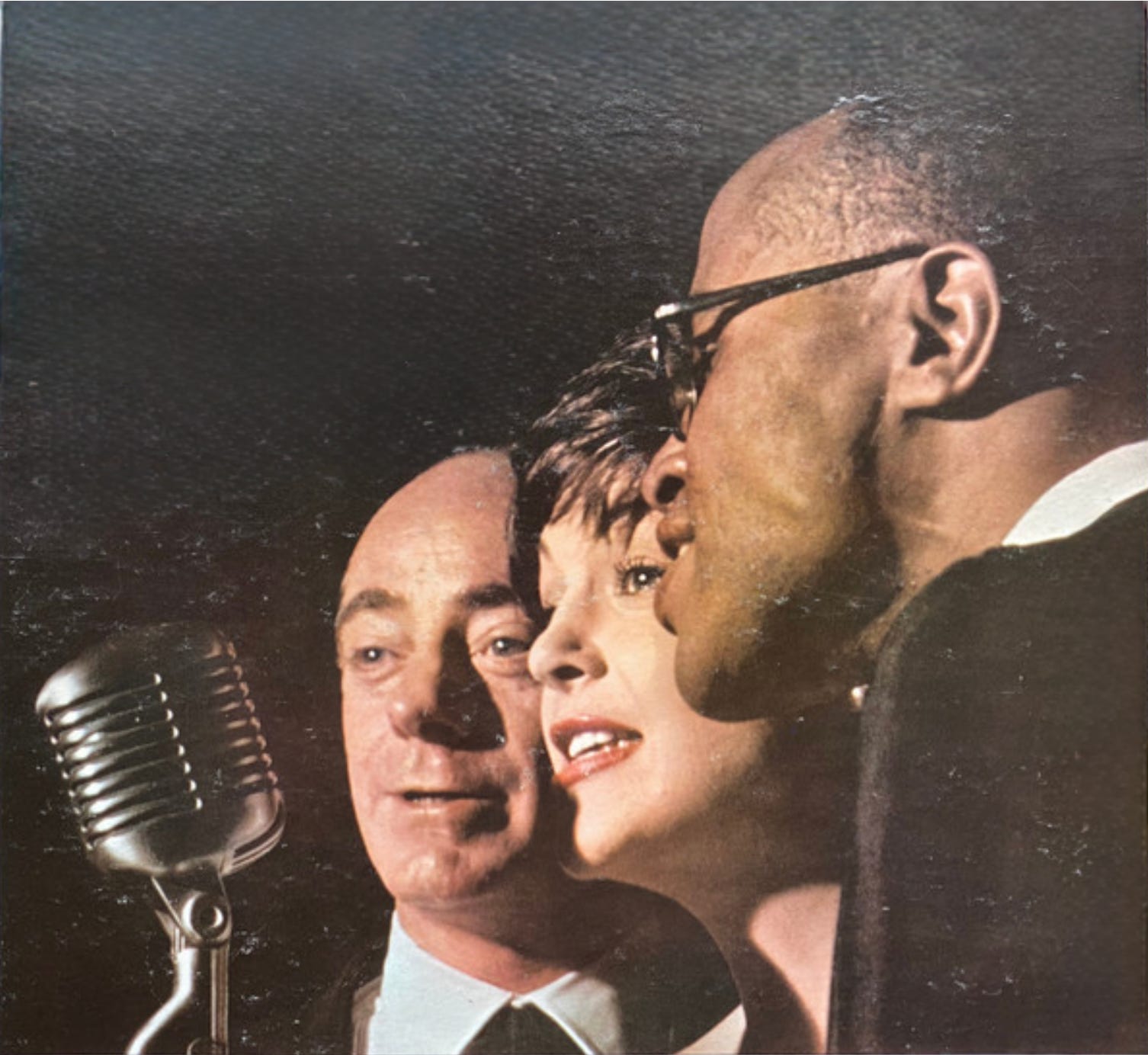
On June 6, the band and its special guests taped an hour-long set on ITV Granada in London. The program was broadcast on June 8 in northwest England and the Isle of Man, between Great Britain and Ireland.
LH&R’s recording relationship with Basie began in 1957, when they recorded Sing a Song of Basie. Produced by Creed Taylor for the ABC Paramount label, the record featured LH&R taking well-known Basie recordings and, through multi-tracking, vocalese lyrics—with Ross handling the trumpets, Hendricks the saxes and Lambert the trombones. In effect, LH&R became a vocal version of the Count Basie Band.
The album was released in 1958 and nominated for a Grammy in 1959. In 1998, the album was inducted into the Grammy Hall of Fame. In a moment, three videos featuring LH&R at their peak, with Count Basie on piano off-camera and Charles “Ike” Isaacs on bass and Sonny Payne on drums.
To read my interview with Jon Hendricks, go here.
To read my interview with Dee Lambert on her father, Dave, go here.
And to read my interview with Yolande Bavan, go here.
Now the YouTube videos…
Here’s LH&R singing Frank Foster’s 1961 updating of Buck Clayton’s arrangement of his 1945 composition Avenue C…
Here’s Bob Mersey’s arrangement of J. Mayo Williams’s composition Rusty, Dusty Blues, made famous by Basie in 1943…
Here’s Buck Clayton’s arrangement of Basie trumpeter Ed Lewis’s composition It’s Sand Man, first recorded in 1942…
Bonus: Here’s O.C. Smith with Lambert Hendricks & Ross and Count Basie and his rhythm section off-camera…
Here they are in July 1961 at the Antibes International Jazz Festival in France singing Everyday I Have the Blues…
And here’s Lambert, Hendricks & Bavan on Jazz Casual, aired in February 1963, with Gildo Mahones (p), George Tucker (b), Jimmie Smith (d) and Pony Poindexter (ss), singing This Could Be the Start of Something Big…
I find it truly amazing that just three voices and a rhythm section could sound like an entire band. They really had something special while it lasted. A great melding of musical minds.
Earlier today, I watched the fantastic clips you selected for us, and just a moment ago, I read your 2009 interview with Jon Hendricks. It struck me how fortunate it was that you launched JazzWax back in 2007. It allowed you to interview many jazz musicians who are no longer with us today. That’s why I really appreciate how you frequently include links to older interviews in your new posts. I’m not familiar with many of them, so these new posts - by featuring links to past interviews - help me learn even more.
And you’re absolutely right: European television networks recorded - and in some cases, produced - so many wonderful concerts that are now available to watch on YouTube. And new footage is being added all the time. And Marc Myers unearths these treasures for us. 😄👍