

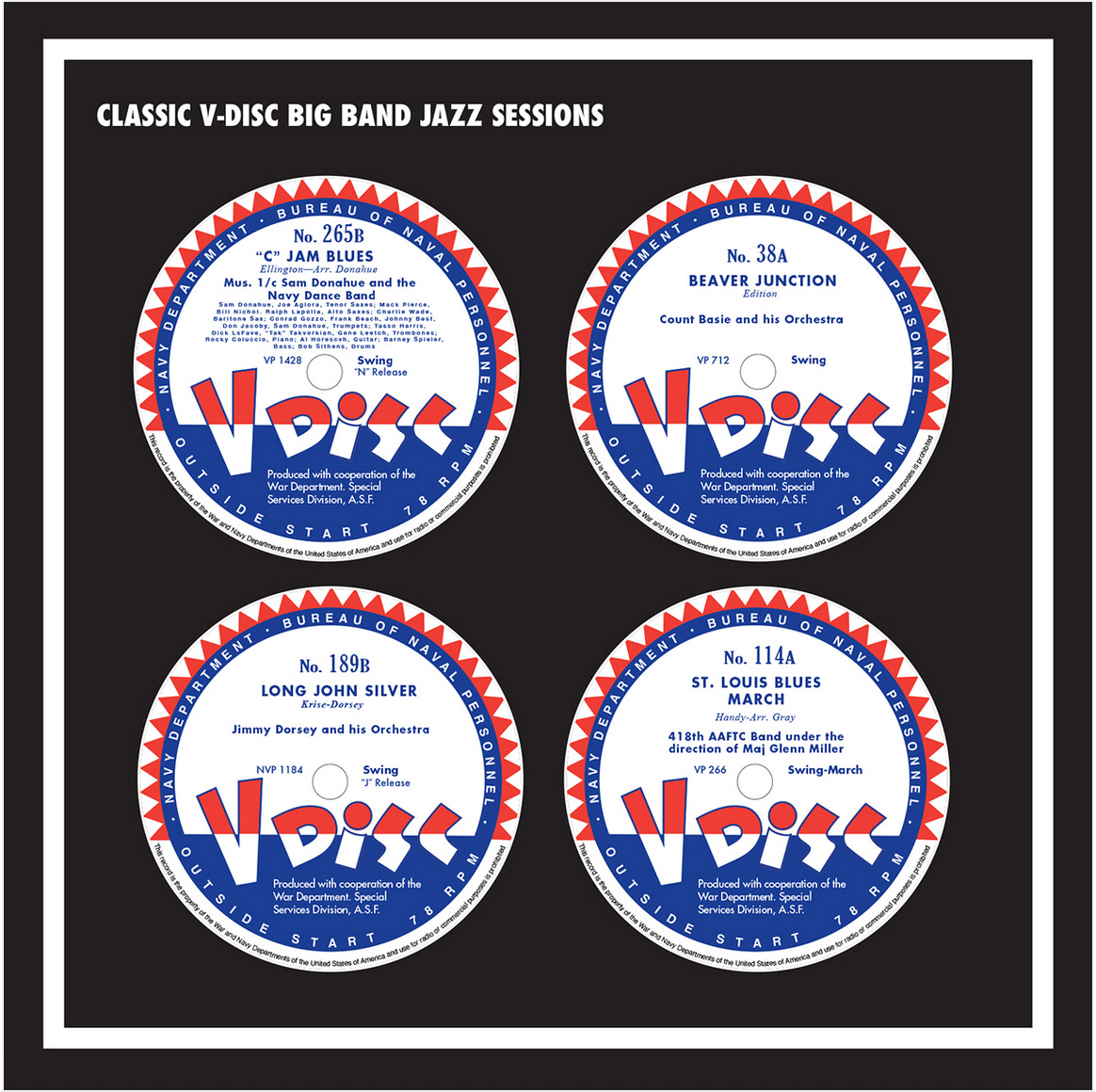
If you’ve read George Simon’s book The Big Bands, first published in 1967, you know there were many more big bands than the five or so that get most of the coverage today. And even if you memorized the book, which details the era that lasted roughly from 1936 to 1947, you probably still don’t know what most of those best bands sounded like during the war, when the national recording ban went into effect.
Now, for the first time in memory, we have a bountiful 10-CD box set that provides a superb survey of the war years and many of the five-star bands of the era. For someone who grew up listening to the big bands before I started listening to jazz, this box took my breath away.
The box set is Classic V-Disc Big Band Jazz Sessions, newly issued by Mosaic. If you’re a big-band fan, this is Mosaic’s finest release since its Artie Shaw: Classic Bluebird and Victor Sessions seven-CD box in 2009 and the Chick Webb box with Ella Fitzgerald in 2013. The tracks on the new V-Disc box run mostly from 1943 to 1945, with a few from 1948, but they smartly don’t appear in chronological order.
The V-Disc (Victory Disc) program was initiated by Lieutenant G. Robert Vincent (George Robert Vincent). He was a sound engineer who headed the program for the U.S. Army during World War II and beyond.
Vincent was quite a negotiator and managed to convince James Petrillo, president of the American Federation of Musicians, to allow union member artists to record for the project despite the recording ban. Since no money was changing hands, Petrillo didn’t really have much of a leg to stand on. He also had a chance to look patriotic, despite depriving the public of new music.
The U.S. government began issuing V-Discs to soliders in 1943, in the middle of World War II. The primary reasons for the program were twofold: To overcome the union recording ban that had begun in 1942 and paralyzed the American recording industry; and to build the morale of troops who had no access to the music that would remind them of friends and family back home and what they were fighting for.
With shellac in short supply due to Japanese occupation of Pacific regions where its natural ingredients were found, and to lighten the load of shipping heavy and fragile shellac 78s, the government manufactured V-Discs on vinyl. Of course, in the LP era starting in 1948, vinyl records would steadily phase out shellac entirely.
The federal program lasted from October 1943 until 1949, distributing over 8 million records to troops on bases. In essence, swing music and the bands helped the U.S. win World War II in Europe and the Pacific. The program also ensured America’s appetite for syncopation and ultimately jazz.
The newly released box is technically a sister set to Mosaic’s Classic V-Disc Small Group Jazz Sessions released in 2024. But there’s no comparison (sorry, sister). For me, the small-group V-Disc box was loaded down with flat, uninteresting and quirky recordings.
By contrast, the big-band box is an astonishing and superbly edited collection of 218 tracks free from novelty material and packed with thoroughly exciting material, thanks to producer Scott Wenzel. What’s job Scott has done. Even bands you’re familiar with will impress you with some songs they never wound up recording for their record labels once the bans (there was a second one in 1948) lifted.
The excellent 11-inch square booklet features detail-rich liner notes by big band scholar Dave Weiner. The many photos and discographical details make the box both educational and a lavishly entertaining journey back to the war years and the musical roots of American optimism.
No matter where you click, you’ll land on songs so good you can’t take off. I’m not exaggerating. I’d be the first to criticize the box if I felt it was soft in places. Believe me, I searched high and low during my three complete listens, but I couldn’t find a track that wasn’t a prime cut for big band fans.
Which makes sense given the V-Disc program’s mandate. The whole point was to excite and motivate G.I. Joes, and that meant swing of the highest order. Uptempo arrangements had to jump, and the ballads had to push soldiers to look for light at the end of the tunnel, not bum them out in misery. To quote from one of the songs by Tommy Dorsey and His Orchestra: Blues No More.
There are many spoken word messages by big-band leaders to servicemen listening to the discs as well as six alternate tracks that are as electrifying as the ones chosen by the V-Disc producers for master pressing.
You can order from Mosaic by going here.
Let’s dive in, and prepare to start snapping:
Here’s Neal Hefti’s arrangement of Jones Beachhead (1944) by Woody Herman and His Orchestra…
Ever hear of Mal Hallett? Most people aren’t familiar with the bandleader. Here’s After All That Gin (1944)…
Here’s Hal McIntyre and His Orchestra playin Danny Hurd’s arrangement of Rockin’ and Ridin’ (1943)…
Here’s June Christy with Stan Kenton singing Gene Roland’s arrangement of That’s the Stuff You Gotta Watch (1945)…
Here’s Buddy Rich’s orchestra playing Jimmy Giuffre’s arrangement for that band of Four Rich Brothers (1948)…
Here’s Count Basie and His Orchestra playing Buster Harding’s arrangement of Beaver Junction (1944)…
And here’s the explosive Harry James band playing Jimmy Mundy’s arrangement of 920 Special (1945)…
Note: Scott Wenzel at Mosaic assures me there are plenty of sets in stock.
He also was transparent about an issue:
When I started sending track info to Gracenote, I noticed a discrepancy on Disc V. The track listing for both the small booklet in the jewel case (V-VI) and the large booklet is missing the tune “Call Me Darling”. Dave properly mentions the tune in the liners and it is correctly listed in the discography. So the correct track listing is:
20. Gee Baby, Ain’t I Good to You
21. Basie Strides Again
22. Call Me Darling
23. Playhouse No. 2
24. K.C. Stride (alt)
Listening to the Buddy Rich band on Four Rich Brothers took me back to a much quieter Buddy Rich playing only brushes on Tatum Group Masterpieces Vol. 3. It’s Tatum, Hampton and Rich, and it’s simply astonishing.
Malcolm Kronby
Thank the Good Lord for Mosaic. Been onto them since their beginning, a pile now waist high.