

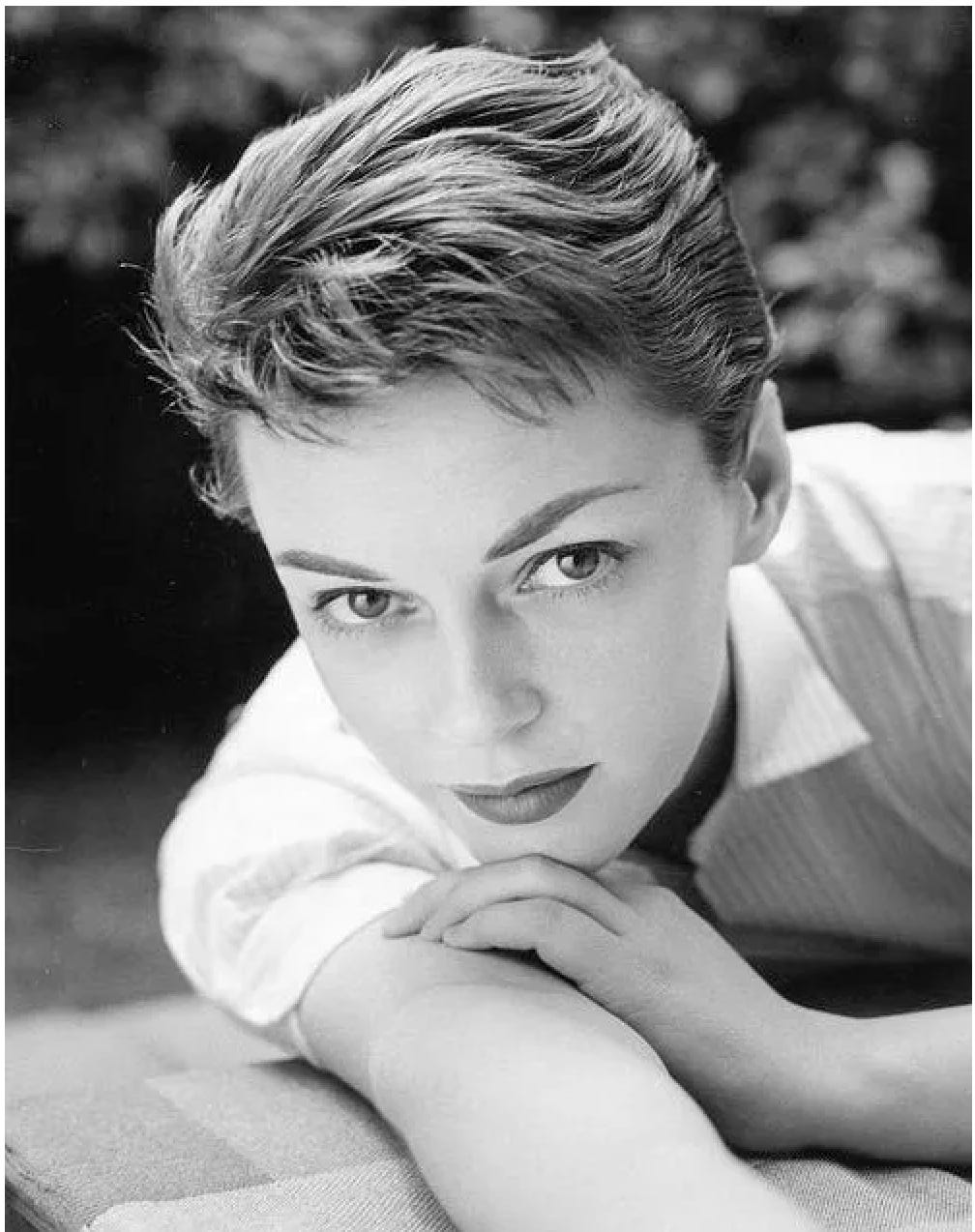
Peggy King, a jazz-pop singer who worked with the Charlie Spivak, Ralph Flanagan and Ray Anthony big bands before making an early leap to television, where her charm and fashion-model looks transformed her into a singing sensation at the dawn of the 1950s, died yesterday, on Oct. 25, at age 96.
Her name may not be familiar to most jazz fans, but in television’s infancy, most shows were hosted by name singers and comedians. The TV and movie industries were competitive rivals then, jockeying for Americans’ spare time. As a result, film actors weren’t given TV host slots. Singers and comedians were better suited for long stretches of live TV and they were far more entertaining than the actors might have been, drawing larger audiences.
In the case of male comedians, they couldn’t do the show alone. Gags and bits ran only so far. Besides, married couples at home tended to be more loyal to shows that featured couples. King was among the most popular of these female co-stars, a girl-next-door type who was enormously talented as a singer and actor, and who became known mid-decade as “pretty, perky Peggy King.”
She appeared opposite Mel Torme on his first show in 1952 and George Gobel from 1954 to ‘57. Then she was a frequent guest on virtually every other host’s show before she married in 1961. But King wasn’t just a pretty face. She often sang a solo on each show as well as a duet with the host or a famous guest, ranging from Frank Sinatra to Tony Bennett.
Here’s my complete 2015 interview with King (a special thanks to drummer Bruce Klauber for alerting me to King’s passing):
JazzWax: Where did you grow up?
Peggy King: In Greensburg, Penn. My parents told me I was “kiddie singing” the minute I could talk. I was an only child and my real name was Peggy King. Many people thought I had changed it. When I was in my teens, I found out I was adopted. I never thought of tracking down my real parents, since my adopted parents were such good people. My birth mother did try to make some contact with me, but I wasn’t interested. It was really too late by the time I found out.
JW: Who was your birth mother?
PK: My adoptive mother had three sisters. One was much younger and could sing. By the time I was in my mid-teens, I figured it out based on her voice. My Aunt Gladys was my mother. My parents—Margaret and Floyd—were married only four months when they adopted me. During the Depression, a lot of adoptions took place as families helped care for children of relatives who couldn’t play that role emotionally or financially. It was a matter of survival, and those who had the means to raise a child to keep it within the family often stepped forward.
JW: What did you tell your Aunt Gladys?
PK: In my teens, I had to sit my birth mother down and tell her that we weren’t going to be reunited. I told her, “You’ve always been my favorite aunt. You can’t be my mother.” She understood. What I got from her was her singing voice.
JW: Did you sing in school?
PK: Yes, I was in all the school plays. Singing to me came naturally, like waking up. I only had had two lessons—that was it. When I was 12 in 1942, we moved to Ravenna, Ohio. My father had been offered a good-paying job during the war at the Ravenna Arsenal. He was in charge of handling the ammunition. There wasn’t a day growing up that I didn’t worry about him. After we moved, I sang in a choir at Kent State, which was a four-mile bus ride away from our house. It’s a wonder I didn’t end up a classical singer, but we didn’t have any money for lessons.
JW: What did you do after you graduated high school?
PK: I graduated at age 16, and when I was 18, I went to Cleveland to sing on the radio during the day and at the Cleveland Hotel nightclub at night. The best part about the gig is that I was given a free room at the hotel. Without that room, I wouldn’t have had enough money to send home to help my parents. Then one night in 1950, Charlie Spivak came into the club and offered me a job.
JW: Was it tough working in that band?
PK: The work was nonstop. The only problem with Spivak was that he was getting a divorce and he hated women. Tommy Leonetti was the band’s male vocalist, and I learned phrasing from him. I always had this ability to learn lyrics and songs instantly. I had total recall when it came to lyrics, which was a great help later in live television. A year later in ‘51, I joined Ralph Flanagan’s orchestra. Someone on the Spivak band had come from Flanagan’s orchestra and told me there was an opening. Frankly I was tiring of Charlie. All of the work with Flanagan was on the road, which was relentless. Flanagan was an odd guy, though. He had his own plane—he didn’t ride with us. When we played Atlantic City, he’d go up in his plane and throw promotional leaflets out to let people know about the gigs.
JW: How long were you with Flanagan?
PK: A year. While I was with Flanagan, we were playing the Paramount Theater in New York when I heard that Mel Torme was holding auditions at a nearby studio for a TV show. He needed a girl singer. When the Flanagan band took a break during the feature movie, I went up to the studio to audition. They had already dismissed the tall girls, since they didn’t want a singer who towered over Mel. When it was my turn, I came into the studio and Mel and another guy were in the control booth. I sang The Boy Next Door backed by the group Mel had planned to use on the show—the Red Norvo Trio. When I finished, this guy came out of the booth, picked me up and kissed and hugged me. He said, “I’m Hugh Martin and I co-wrote that song. Besides Judy [Garland], I’ve never heard anyone else sing it like that.”
JW: You got the job?
PK: I did. The Mel Torme Show went on the air in 1952. All I had to do is pick up the rest of my clothes back home in Ohio. At the time, I was dating Knobby Lee, one of Flanagan’s trumpet players. When Knobby and I returned to New York, we got married. For me, I wasn’t madly in love but I needed someone around me for safety. I couldn’t be in New York alone. I was very young—19. But the marriage was a mistake. We married in ’51 and stayed together for two years.
JW: You were on TV early.
PK: It was the dawn of television, and there was no model for what we were doing. The first Mel Torme Show was on NBC. It was live, often on the fly and pretty scary. They didn’t’ know what they were doing. The cameramen were all staring at each other. But it all came together pretty fast. Mel (above) was a control freak, which helped a lot. He showed me what to do, and within a week I was comfortable.
JW: How were you able to ease into TV so quickly?
PK: Without the two previous years of steady big-band experience, I doubt I could have handled the fast-paced pace of that TV show. Red Norvo liked my singing and helped me a great deal. Mel had been my hero in the late ‘40s. He was young, but he had this sophisticated, relaxed jazz sound. We got along great. Mel and I sang a duet on each show and I sang one alone. I’d often learn which songs we were going to sing the morning of the show.
JW: How did you wind up at MGM?
PK: In 1952, I went into New York’s Blue Angel for a run. One night, Arthur Freed, the head of MGM, came backstage and offered me a contract. I knew it was a big shot for me, so I told Knobby and he came out to L.A. with me. There was a gap between the date of the offer and the start date, so I went out on the road with the Ray Anthony Orchestra. Being alone out on the road was tough.
JW: What did they teach you at MGM?
PK: I had the best vocal coach there—Bobby Tucker. My voice always had a young sound, and Bobby said, “Let’s stick with what you’ve got since others don’t have it.” Everyone was wonderful to me at Metro. Tucker was very supportive and said, “I can’t teach you anything you don’t already know,” so he focused on teaching me every major standard in the American Songbook. I also worked with speech coach Gertrude Fogler to get rid of my Pittsburgh accent.
JW: Who were your friends at MGM?
PK: I met Debbie Reynolds almost immediately. I was having a tap lesson and she was, too. But when I opened the box with my shoes, I saw that my dog had chewed up the laces. Debbie offered me a pair, since we were the same size—5½. We became good friends. She asked me where I was staying. I told her at a hotel. She invited me to stay at her house for a couple of weeks. I was there for two months until I found a small room in Beverly Hills. MGM was in Culver City, and I couldn’t drive. Fortunately, Robert Burton, an extra who lived in my building, gave me a lift each day.
JW: You were constantly being compared to Judy Garland, weren’t you?
PK: I was. Everyone thought I looked and sounded like her. I guess I did a little, but it wasn’t intentional. That was just me. I actually met Judy just after I signed my contract. I was in the MGM commissary getting lunch and sat down at the same long table where she was eating. She turned to me and said, “Are you the one who looks like me?” I didn’t know what to say, so I said, “Yes, I guess so.” She said, “You don’t look like me—you’re really pretty.” I felt terrible for her. I paused, sort of taken aback, and then said, “I think you’re pretty.” She reached over and squeezed my hand. The poor woman had no self-esteem. The studio had destroyed her to control her.
JW: What did you do at MGM?
PK: I was an extra, but I was constantly the last girl cut from a film. Then in 1953, when my contract was up, I heard about a new local NBC TV show where the girl had to be able to sing and interact with the audience—sort of like a singing Vanna White. It was a two-hour live show, and I got to sing. I had my own dressing room and everyone in town was watching me on TV. I was thrilled.
JW: What was your big break?
PK: One day I got a call from someone I knew who was rehearsing The Bing Crosby Show. The girl singer had become ill, so I ran over to fill in. When I rushed into the lobby, I asked the first person I saw where the show was. I said, “I’m looking for Mr. Crosby.” The guy said, “Well, you’ve found him.” He didn’t have his hairpiece on and I thought he was the janitor. On the set, John Scott Trotter was the orchestra leader. He said, “What do you want to sing?” I said let’s do two Rodgers and Hart songs. When I was finished, Bing said, “Wow, you’re as good as Uncle John said you were.” I felt so good about that.
JW: What happened after the rehearsal?
PK: When I returned home, I received a call from John. He said he wanted me to audition for George Gobel, who was starting a Saturday night network TV show. I flipped. I said, “I’m not experienced enough to do that.” John said, “Don’t worry, I’m the orchestra leader. You’ll be fine. I want to see you at the studio.” So I went. George played guitar, sang country songs and made jokes. He was a natural for TV. The writers wrote wonderful stuff for him. He was loose and I was just the right height—5 feet, 1½ inches. I got the job. On the show, George wore lifts, so I was slightly shorter. I was always afraid he was going to fall but he never did.
JW: Were you nervous as the co-star of The George Gobel Show? Even though TV was in its infancy, it was a live network show reaching millions of people.
PK: By the time I got there in ‘54, I was at home in front of a TV camera. For the next 2½ years while the show was on the air, I performed with every major actor and singer, from Jimmy Stewart to Frank Sinatra. It was a major network show and the ratings were huge. One of the show’s writers came up with “Pretty Perky Peggy King” and it stuck. I didn’t mind. My aim was to save enough to buy my folks a house—and in 1954 I did.
JW: They must have been overjoyed.
PK: They were. My father wasn’t from a fancy family. He worked his whole life. Mother’s parents had died and she was raised in an orphanage. When I became famous, people followed them down the street. My fame scared them and I felt bad.
JW: You must have known Dinah Shore while at NBC.
PK: I did. My dressing room was right next to hers. She was so lovely and very much a lady. She could not have been kinder to me. If she passed my dressing room while I was rehearsing, she’d always pop in with a kind word. She’d say, “I love how you did this or that.” It’s kind of mind-boggling that Dinah would say that to me.
JW: In the early days of television, you must have been something of a celebrity in Los Angeles, as the suburbs and TV viewership grew.
PK: It’s funny, I actually was. Debbie Reynolds and I remained friends after I left MGM. One night, while I was still on George Gobel’s show, Debbie, Jane Powell and I went to the movies. As we walked down Hollywood Boulevard to the theater, people on the street recognized only me. Back then, people lived for TV. It was new and convenient and more intimate than the movies. The three of us laughed our heads off. Debbie and Jane were happy not to be recognized.
JW: You also recorded singles and albums for Columbia. How did that happen?
PK: After three months on the George Gobel Show, Mitch Miller called to sign me to Columbia. I recorded my first album in Hollywood with Jerry Vale—Girl Meets Boy (1955), with the Percy Faith Orchestra. At that point, I had been on TV and in plays as well as in films. I had done it all and was very comfortable in the recording studio. When we sang songs from the album on TV, Jerry was a little nervous. He had never been on TV before. We did our duets holding hands.
JW: You’ve always had a young-sounding voice.
PK: Yes, there was always a teenage quality to my voice. People told me that all the time. It’s probably because I never smoked. I like that people thought I sounded like the girl next door. That’s the way I was portrayed on George’s show. I might add, George was the dearest man in show business. He wasn’t in love with himself. The first month we were on, when people in the press were calling me and my picture was in one of those Hollywood magazines, George said, “You’re really getting famous.” He never felt angry or envious. He knew that the more popular I became, the more popular his show would become.
JW: You also worked with your share of top comedians. Was that tricky—making sure you didn’t laugh too soon?
PK: Jack Benny was my favorite. The strange thing is he was anything but tight with his money. He was a very generous guy. I did a five-week tour with him. He thought I was a good straight-man. It was hard not to laugh at Jack.
JW: How did you avoid doing that and blowing his jokes?
PK: It has to do with being an actress. You develop a sense of timing. I learned my timing from Jack and Bob Hope. The trick is to listen very carefully to what’s being said, even though you’ve rehearsed it. When Jack or Bob delivered the line, I had a way of counting to myself, “One, two—then I’d make a little face,” which would compound audience laughter. You have to put the punch line out of your mind and imagine you haven’t heard it before. Otherwise, you’d instinctively telegraph it. Working with Jack was a little harder than most because he made those great faces on his own. So I had to avoid laughing and wait until he finished completely before making my face. I also did this with TV, in general. I just thought of it as radio with everybody staring at you. I got to the point where I didn’t think about the lens much. I just thought about what I was doing.
JW: I’m curious about early television. How would a typical week on the Gobel show go?
PK: We’d come in on Tuesday afternoon and just read through the script. Then we’d take the script home and work on it at home. I’d fall into it and read my lines out loud to remember them. Once I saw a script and went through it, I knew it cold. My brain just worked that way. On Wednesday, we’d start blocking—marking off where each of us would stand, who’s going to talk when and what’s going to happen next. Everyone had a different color tape. Mine was red and George’s was blue. On Thursday we’d work with John Scott Trotter and just the band’s rhythm section. Friday was a full dress rehearsal, which left me with very little time to get a dress fitted. Eventually I had a model with my proportions stand in for the fittings. Saturday was the show, when we often had a guest.
JW: Did you ever sing a duet with a famous guest and the other person forgot a line?
PK: Plenty of times. I can remember staring into famous faces and suddenly saw nothing there. Singing a duet is like performing in a live play. You don’t have a chance to take anything back. In radio at least you have a script in hand. On TV, I’d see panic crawling across the other person’s face. That’s when I’d try to throw them a line. Or I would sing the line right in their face or I’d sing their line. I was so used to looking out for trouble and thinking on my feet.
JW: You started appearing on Steve Allen’s shows in the late 1950s. What was he like?
PK: Steve was a wonderful, generous man. My favorite clip was Steve introducing me on my birthday in 1958. Steve was more of an actor than George [Gobel]. I always felt like Steve’s little sister. He was so natural. Maybe I learned that from him. I’d try to imitate the way he behaved. I also learned timing from Steve—how long to hang onto something and how long to stare at someone before moving on. Steve was so cool and natural it was almost like he was going off to sleep. Bing was like that. It’s the look in their eyes. Zero panic, full control.
JW: You were in Abbott & Costello Meet the Mummy (1955). How did you meet them?
PK: I used to open for Bud and Lou when they did their act. They had tracked me down after they saw me at MGM. They asked me to go on the road with them. Nobody was better at getting audience to commiserate with him than Lou. That wasn’t easy, and I had to watch that with George. Linger too long with that audience glance and it looks like you’re making fun of the other person. What I finally ended up doing is making myself seem younger than George. This made me George’s little sister rather than his love interest. I did it without being sexy and avoided flirting with him.
JW: Did you ever want to host your own show?
PK: No, I never gave it much thought. Dinah was unhappy doing her show. In fact, I never knew anyone who was happy headlining a TV show. They never could relax because everything was on their shoulders. On the George Gobel Show, it wasn’t my show—it was George’s. So I could be more relaxed. At one point NBC talked to me about a show. I told them I just liked being the girl on the show. When I saw what George had to go through, I realized that you didn’t have a life at all. Many ended up drinking. My father was an alcoholic and I wanted to stay away from that.
JW: Your recordings for Columbia were straight-up pop, yet you could swing.
PK: It was my big band experience. I wanted to record jazz, and you can see that I could do it when I was on Bobby Troup’s Stars of Jazz in ‘58, when I was engaged to Andre Previn. I always had that touch of jazz. The problem is Mitch Miller wanted me to stay a little girl. Mitch would give me these awful songs and tell me no one else could sing them. I learned later that they were actually the songs nobody else wanted to sing.
JW: So you were trapped.
PK: For whatever reason, Mitch didn’t think of me as a woman but as a child. Mitch wanted a commercial sound from me and that was it. He had arrangements written that confined me to the next Judy or a 14-year-old. Jo Stafford once told me that Mitch was tough to handle on a record date. You simply didn’t have any say. When I recorded for him, I’d do four songs in three hours and there were no second takes. It had nothing to do with me. There was Mitch and there was the rest of the world. Once you signed a contract, it was hard to get out of it. Not until I was able to get away from Columbia and record on my own was I able to sing jazzier material.
JW: How did you meet your husband, Sam Rudofker?
PK: One day in 1960, when I was performing at Mr. Kelly’s in Chicago, columnist Irv Kupcinet brought him in. Irv said later it was like watching someone fall off a roof. He told me Sam (above) said, “She’s the most wonderful thing I’ve ever seen in my life.” I think Irv did that deliberately, to fix us up. I knew within a week that I was going to quit the business and marry him. In 1961 we married.
JW: Were you happy to give up show business?
PK: Frankly, I had had it up to here with the business. I wanted a family. After I met Sam, I knew he was the one. He had this thing about me. I just knew I’d be safe and happy with him, that he’d give me the freedom to be me and that he’d be nice to my parents. Sam owned After Six, the Philadelphia formal-wear company. In his hands, I knew I’d be in good care. He had two boys when I met him. I knew I wanted to have children with him. I was 30. Sam was so charming. The best man I ever knew. Nothing icky about him. He had quite a vocabulary and was witty. We had two children—a son, Jonathan, and a daughter, Suzy. I lost Jonathan about 10 years ago. He was a brilliant violinist. My daughter is wonderful and beautiful.
JW: How would you prefer to be remembered?
PK: As an actress who sings. I’d like to think someone would read that.
Here’s Peggy King on the Steve Allen Show in 1958 (the sound is a little rubbery)...
Here’s Peggy King in 1955 on What’s My Line? (at 19:15)...
Here’s King on The Stars of Jazz in 1958…
Here’s a career-spanning video...
And here’s Let’s Fall in Love on the 2015 album Songs a la King (Fresh Sound), with producer, arranger and pianist Andy Kahn, bassist Bruce Kaminsky and drummer Bruce Klauber…
What a tremendous interview! Kudos to you, Marc, for shining a light on Peggy's story.