

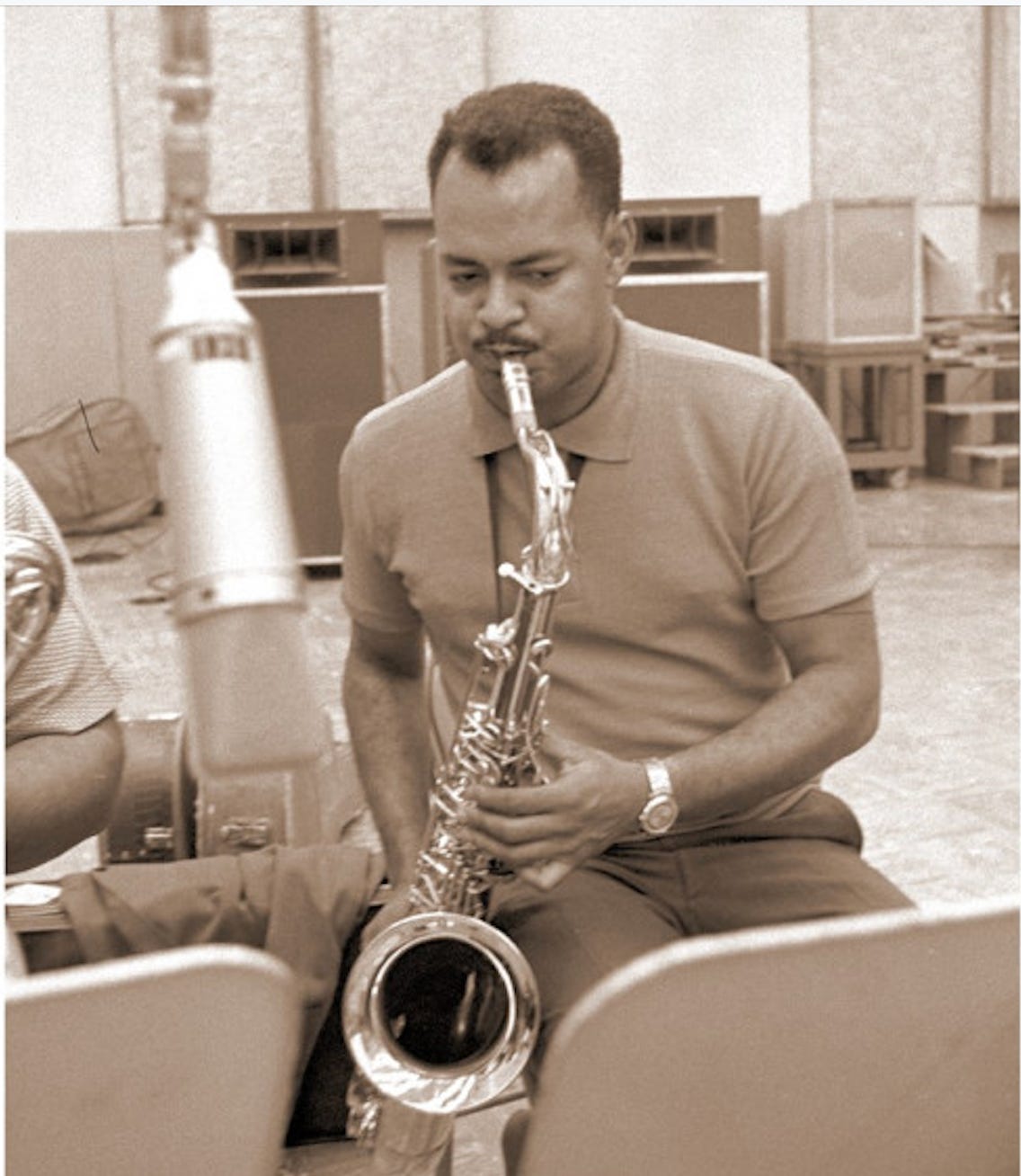
Plas Johnson, a tenor saxophonist who was a jump-blues specialist in the late 1940s, an R&B sideman in the 1950s and a studio session player in the years ahead, often called upon to add a smooth, earthy touch on recordings such as Henry Mancini’s Pink Panther Theme, died on July 15. He was 94. [Photo above of Plas Johnson in the 1960s]
Johnson was largely self-taught by ear and picked up his early phrasing by mirroring the tone of his father, a professional saxophonist. In the early 1950s, he attended the Westlake School of Music in Los Angeles after serving in the Army starting in 1951.
The school was established in 1945 to capitalize on the GI Bill, which subsidized the tuitions of veterans. At Westlake, musicians skipped much of the classical training required by other more established music conservatories and was among the first to focus on teaching musicians how to be commercial arrangers, composers and players.
Johnson didn’t complete his schooling there due to his mounting recording schedule in Hollywood, thanks to the growing use of magnetic tape and recorders in studios and the 10-inch 33 1/3 LP, which was replaced by the 12-inch by 1955 and ‘56.
Early on in his career, Johnson played on R&B sessions with Art Farmer and other jazz players moonlighting on blues dates, pianist and arranger Ernie Freeman, and a virtual who’s who of players in soul, pop and jazz throughout his career. In the 1960s and ‘70s, he recorded extensively on boxes arranged by Billy May that re-recorded the books of swing-era big bands.
Johnson appeared on an extraordinary number of albums over the course of his career. Going through his discography, you find many jazz, R&B and jazz-pop albums that were huge sellers and many that are still little-known. One is Ray Anthony Plays Steve Allen, featured in full below.
I’ve pulled together 19 favorite tracks featuring Plas Johnson over the course of his lengthy career:
Here’s Johnson’s first recording session, backing singer Erline Harris on Jump & Shout. His brother Ray was on piano and the rest are unknown. It was recorded in New Orleans in 1949…
Here’s Johnson with vocalist Ike Lloyd singing The One I Love. He’s backed by Johnson along with Art Farmer and George Orendorff (tp), Earl Brown (as), Lloyd Glenn (p), Pee Wee Crayton (g), Billy Hadnott (b) and Bob Harvey (d) in 1951…
Here’s vocalist “Woo Woo” Moore singing Something’s Wrong, backed by Johnson, and Art Farmer (tp), Jewell Grant (as), Raymond Johnson (p), Roy Hayes (g), Eddie Williams (b) and Jesse Sailes (d) in 1953…
Here’s drummer George Jenkins playing Drum Tattoo, backed by Plas and Ray Johnson and Duke Harris (b) in 1955 (my apologies for the awful Drum Stuff cover along the way)…
Here’s Plas and Ray Johnson with an unknown baritone saxophonist, Duke Harris (b) and George Jenkins (d) playing Plas’s Blue Jean Shuffle in 1956…
Here’s the full rare album Scooby Doo, with Johnson soloing, backed by John Anderson (tp), John “Streamline” Ewing (tb), Dave Pell (bs), Raymond Martinez (reeds), Irving Ashby (g) Ad Alshbrod (b) Jewel Grant (d) and Jerry Leiber (dir) in 1956…
Here’s organist Earl Grant playing The Second Time Around with Johnson, backed by Al Hendrickson and Bobby Gibbons (g), Morty Corb (b) and Jack Sperling (d); the date is unknown…
Here are the Strollers playing Jumpin’ With Symphony Sid, featuring Plas Johnson (fl), Al Viola (g), Wilfred Middlebrooks (b) and Earl Palmer (d) in 1958…
Here’s the entire album Ray Anthony Plays Steve Allen, a killer, featuring Ray Anthony, Pete Candoli, Conrad Gozzo and Gene Duermeyer (tp); Frank Lane, Lewis McGreery and Tommy Pederson (tb); Skeets Herfurt and Ronnie Lang (cl,as); Bob Hardaway and Plas Johnson (ts); Med Flory (bs); John Bannister (p); Bobby Gibbons (g); Don Simpson (b,arr); Alvin Stoller (d) and the Skyliners (vcl) in 1958…
Here’s Johnson soloing on Spook!, from Henry Mancini’s More Music From Peter Gunn, in 1959. The band: Conrad Gozzo, Pete Candoli, Graham Young and Frank Beach (tp); Dick Nash, Jimmy Priddy, Hoyt Bohannon and Karl DeKarske (tb); Paul Horn (fl,as); Ted Nash (fl,pc,ts); Plas Johnson (ts); Gene Cipriano (saxes); Ronnie Lang (bs); John T. Williams (p); Victor Feldman (vib); Bob Bain (g); Rollie Bundock (b) and Shelly Manne (d)…
Here’s Plas and Ray Johnson on One Mint Julep in 1960, backed by Ernie Freeman (org), Rene Hall (g), Bill Pitman (g), Red Callender (b), Earl Palmer (d), strings and Gerald Wilson (arr)…
Here’s another little-known gem—Johnson playing on Pete Rugolo’s 10 Saxophones and 2 Basses. The track is a medley of Four Brothers and Early Autumn. The band: Skeets Herfurt, Bud Shank and Gus Bivona (as); Russ Cheever (sop); Bob Cooper, Plas Johnson and Gene Cipriano (ts); Bill Perkins (ts,bar); Chuck Gentry and Bill Hood (bassoon,bass sax); Jimmy Rowles (p); Howard Roberts (g); Red Mitchell and Joe Mondragon (b); Shelly Manne (d) and Pete Rugolo (arr,cond) in 1961…
In 1963, Johnson used a pseudonym—Johnny Beecher—and recorded a couple of albums for the Charter label, one of which was Sax 5th Avenue. Here he’s playing the title track backed by Emil Richards (vib), Bert Kendricks (org), Jimmy Bond (b) and Earl Palmer or Wayne Robinson (d)…
Here’s Johnson playing the title track from his 1964 album called Blue Martini, with an unknown orchestra conducted by John Neel…
Here’s Johnson soloing on Brunette in Yellow from Mancini’s soundtrack for the film The Party, in 1968…
Here’s Johnson playing Our Day Will Will Come from his 1975 album The Blues, with Mike Melvoin (p,el-p), Herb Ellis (g), Ray Brown (b), Jake Hanna (d) and Bobbye Hall (cga)…
Here’s Johnson playing That’s All from Wild Bill Davis’s 1990 album of the same name. The Super Trio featured Johnson (ts), Wild Bill Davis (org) and Butch Miles (d)…
Here’s Johnson on The Next Time You See Me, from Rhoda Scott’s From C to Shining C in 2006, with Scott (org), Carl Lockett (g) and Lucien Dobat (d)…
And finally, here’s Johnson in 1983 on the cable-TV variety show Steve Allen's Music Room reprising his 1963 solo on Mancini’s The Pink Panther Theme. I see Pete and Conte Candoli in the trumpet section and Med Flory in the reed section. See the comments below for the full personnel from Bill Kirchner…
A special thanks to reader James D. C. Barrall, a senior fellow in residence at the UCLA School of Law, for the heads-up last week.
On the 1983 "Steve Allen's Music Room" TV show, with Plas Johnson playing "The Pink Panther," here's the band:
Terry Gibbs Band personnel:
Trumpets:
John Audino, Pete Candoli, Conte Candoli, Bill Berry
Trombones:
Carl Fontana, Charlie Loper, Dick "Slide" Hyde
Saxophones:
Med Flory, Gus Bivona, Plas Johnson, Jerome Richardson, Bill Green
Piano: Alan Broadbent
Bass: Chuck Berghofer
Drums: Frank Capp
Vibes & Conductor: Terry Gibbs
As one who worked with Ray Anthony in the mid-1980s, I can attest that he was/is (and still alive at this writing) much hipper than he is normally credited. The band here is an excellent L.A. studio ensemble, and Steve Allen's tunes are typically serviceable if undistinguished. But the key question here is: who wrote the Basie-style arrangements? My guesses are Ernie Wilkins or Manny Albam, both of whom contributed to many such ad hoc projects in the 1950s and '60s.