

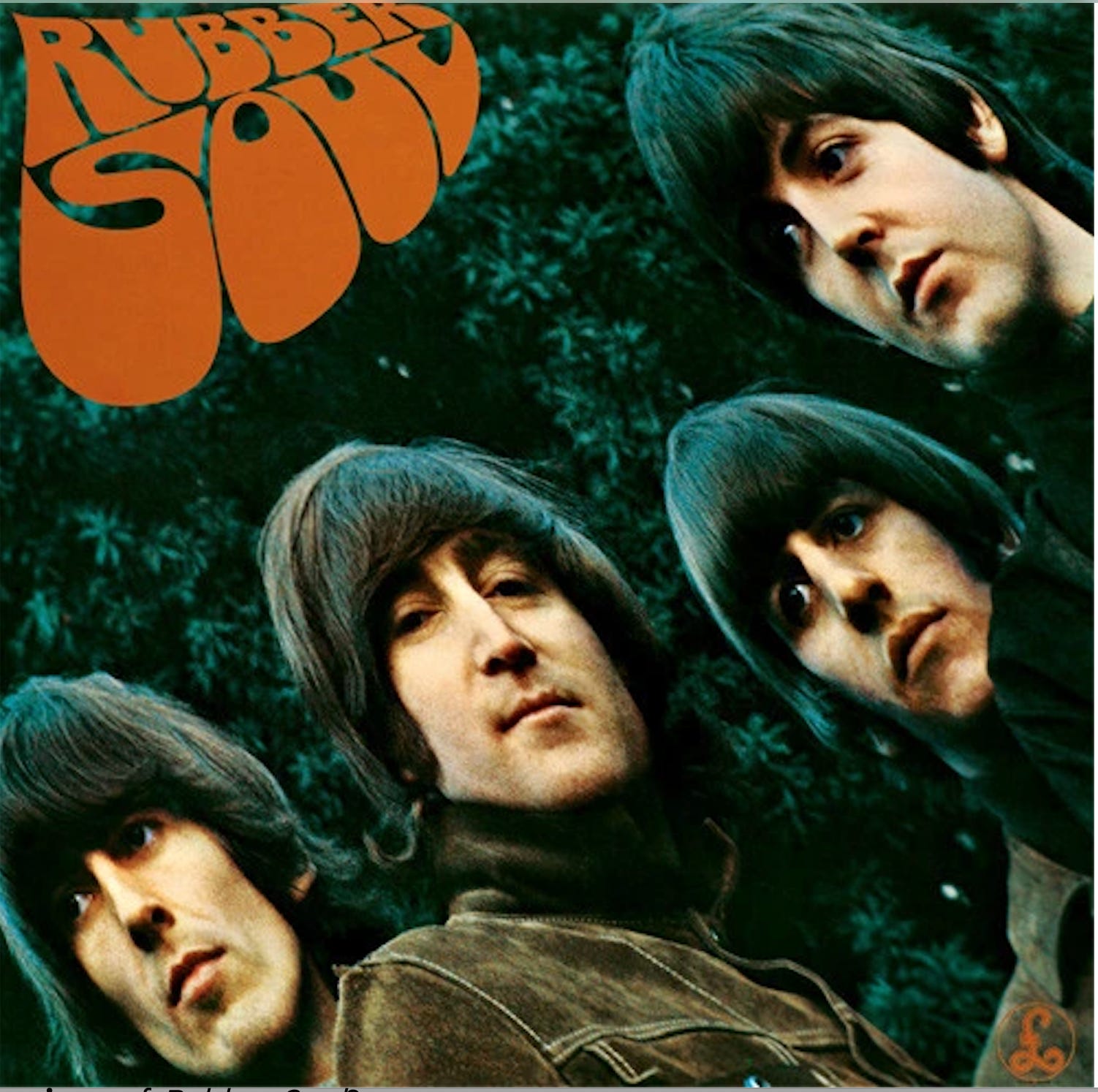
I spent much of yesterday listening to the newly released special edition of the Beatles’ Rubber Soul. Originally issued on Dec. 3, 1965 in the U.K. and three days later in the U.S., the album has been newly mixed by Giles Martin (George Martin’s son) and Sam Okell (the Grammy-winning engineer who has worked on remixes for recent box sets centered on individual Beatles albums).
The sound on the new set is clean, distinct and lavish, with additional sonic information that will be new to the ear. The music is more alive and springs from the speakers, and the vocals are more dimensional and colorful.
For American consumers who grew up in the 1960s, you’ll be compelled to confront the fact that Rubber Soul issued by EMI’s Parlophone label in the U.K. was a very different product and experience than the one Capitol issued here. In short, the British Rubber Soul is a combination of the songs we listened to here on the album plus four that would wind up on our Yesterday and Today.
The strategy for EMI was simple: Record buyers in the U.K. were reluctant to shell out for albums unless there were 14 songs. In the U.S., we (or our parents) were willing to pay for 12. I’m not a stranger to both versions, though I grew up with the America Rubber Soul and still have my original LP and listen to it.
The American release (with toasted brown lettering on the cover) was like a great book you read in the quiet of a forest—each song was a chapter that had a specific order and vibe. The British version (with burnt orange lettering) seemed all over the place, stylistically. In essence, the U.K. LP was envisioned as an art-pop experience while ours had a folk-rock feel, largely to show-up Bob Dylan and win over his fans.
The U.K. vinyl opened with Drive My Car and included tracks such as Nowhere Man, If I Needed Someone and What Goes On. The U.S. vinyl omitted the songs above and added two songs pulled from the British version of Help! (I’ve Just Seen a Face and It’s Only Love).
The newly mixed Rubber Soul comes in 10 formats: standard 1CD and 1LP editions, 2CD and 2LP Special Editions, and 4CD and 5LP Super Deluxe editions. The collection will also be available on Blu-ray, featuring the new Dolby Atmos mix, high-resolution stereo audio and promotional films for Day Tripper and We Can Work It Out, alongside limited-edition orange vinyl and D2C exclusive Zoetrope vinyl editions.
To buy the Beatles’ new Rubber Soul, shop through the different formats here.
Today, something a little different. Here’s my Wall Street Journal piece on the album’s 50th anniversary in 2015:
***
The Wall Street Journal/Dec. 2, 2015
The Beatles’ ‘Rubber Soul’ Turns 50
Is it possible to make a better Beatles? Debating different versions of an iconic album
©By Marc Myers (all rights reserved)
For most American teens, the arrival of the Beatles’ “Rubber Soul” 50 years ago was unsettling. Instead of cheerleading for love, the album’s songs held cryptic messages about thinking for yourself, the hypnotic power of women, something called “getting high” and bedding down with the opposite sex. Clearly, growing up wasn’t going to be easy.
Released in the U.K. on Dec. 3, 1965, and in the U.S. three days later, “Rubber Soul” remains one of the most critically acclaimed albums in rock history, influencing a generation of artists, including Brian Wilson, Bob Dylan and Stevie Wonder. It also marked rock’s shift from formulaic pop to studio experimentation and high art.
But while “Rubber Soul” has been hailed as an epic masterpiece and one of the first fully developed folk-rock albums, the vision for the U.S. release wasn’t entirely the work of John, Paul, George and Ringo or the Beatles’ producer, George Martin.
The 12-song album issued in the U.S. was markedly different from the British version, which featured 14 songs. Though both versions shared Robert Freeman’s cover photo and psychedelic lettering (ginger here and burnt orange in the U.K.), the U.S. version dropped two songs and replaced two others.
Over the years, many U.S. critics have hailed the British release as the true masterpiece, a pure reflection of what the Beatles and Mr. Martin intended. But the U.S. version of “Rubber Soul,” with its more consistently poetic sound and narrative, is arguably the more powerful statement. It’s also the version that changed the direction of American rock.
The invisible hand behind the U.S. release belonged to Dave Dexter Jr., the head of Capitol’s international A&R in Los Angeles. Dexter and his team set out to keep the compelling folk narrative running throughout the album.
In 1965, Capitol had contractual permission to alter British versions of Beatles albums for the U.S. market. The agreement dated back to 1955, when British EMI purchased Capitol. At the time, EMI didn’t want to lose U.S. executives and figured they’d know best how to milk their own market.
Once the Beatles were signed to Capitol in late 1963, Dexter was put in charge of reprogramming U.K. versions of their albums for the U.S. market. U.S. versions usually used 11 songs to stay within licensing budgets. The dropped songs were then used on subsequent albums released only in the U.S.
But by late 1965 the Beatles had a problem. Bob Dylan’s album “Highway 61 Revisited” and the single “Like a Rolling Stone,” with its socially conscious folk-rock theme, was resonating with draft-age listeners in the States. To remain relevant, the Beatles needed a more mature, acoustic album.
Fresh off their successful stadium tour in August ’65, the Beatles returned to London and recorded “Rubber Soul” in just four weeks. When the recording was completed, a master reel was shipped to Dexter in Hollywood.
Earlier that fall, Brian Epstein, the Beatles’ manager, spoke with Voyle Gilmore, Capitol’s head of U.S. A&R. Gilmore, in turn, wrote a memo to Capitol president Alan Livingston and Dexter urging that the cover and tracks for the American “Rubber Soul” be identical to the British version.
Dexter pushed back, explaining that a 14-song album was out of the question due to costs and that the covers should be different. Capitol compromised by featuring 12 songs instead of the customary 11 but retained the same covers.
Then Dexter went to work on the U.S. track list. Instead of just dropping two songs, he replaced the raucous “Drive My Car” and cornball “What Goes On,” which opened sides 1 and 2, respectively, on the U.K. version.
In those critical lead-in slots, he inserted “I’ve Just Seen a Face” and “It’s Only Love”—acoustic songs he had cut from the British version of “Help!” for its U.S. release. Next, he dropped the alienating “Nowhere Man” and mystical “If I Needed Someone” from “Rubber Soul.”
All of the changes were brilliant and resulted in a more cohesive album. But when the U.S. version was released, the Beatles voiced displeasure to EMI, which demanded that Dexter no longer work on Beatles releases. In early 1966, Dexter was replaced by Bill Miller, who programmed the next two U.S. releases—“Yesterday and Today” and “Revolver.”
Today, most Beatles fans view Dexter, who died in 1990, as a villainous rock-hating executive who resented the Beatles and whose programming approach diluted the band’s U.S. releases.
Whatever Dexter’s shortcomings, the Beatles albums he programmed for Capitol are the ones American teens heard and loved. As for “Rubber Soul,” it may have been his greatest achievement, turning an unfocused album into a taut acoustic story of self-awareness and romantic confusion. It also provided millions in the U.S. with their first gentle glimpse of adulthood.
***
Here’s the full British version of the newly mixed Rubber Soul at YouTube…
Here’s Giles Martin on SiriusXM in July talking about the Rubber Soul project…
I was fortunate enough, as a teenager, to have a record store that carried British import LPs, and they only charged a little bit extra for them. So, I had the British pressings of the Beatles albums. Thanks to my connections once I was employed by a radio station, I also had TWO copies of the "Butcher Block" cover on the "Yesterday And Today" album. One went into a nicely sealed padded envelope (I KNEW it would be worth something someday).
I sold the stored copy to pay for my foster father's funeral. Someone stole my other copy. The British pressings of the Beatles albums are in storage. When I downsized, I only kept about 50 LPs out of the thousands I had.
Thanks Marc!
A seminal record for the Beatles, and to be completely self centered, me and my friends. I was 14 when Rubber Soul came out, and while we inhaled it (no pun) as eagerly as we had all other Beatles' offerings, this one was what would be the first revolutionary LP. My peers weren't too lyric focused so we paid attention to the instrumental innovations. Particularly, the sitar on "Norwegian Wood." One of my buddies even did an extensive oral report in class on the raga.
Decades later, a fellow music head and I were rehashing records and I talked about all of us in my Long Island high school were obsessed with the use of that sitar by George Harrison. My fellow muso, born and bred in the hotbed of the LA music scene told me it wasn't so special.
"The Byrds used it six months before the Beatles."
To the LA crowd, no one was cooler than the Byrds. Me? I loved them too, but they were always way ahead of the pulse. The Beatles were a millisecond ahead. Their instincts anticipated the very instant we were all ready to accept the "new."
I'd rather be the Beatles than the Byrds.