

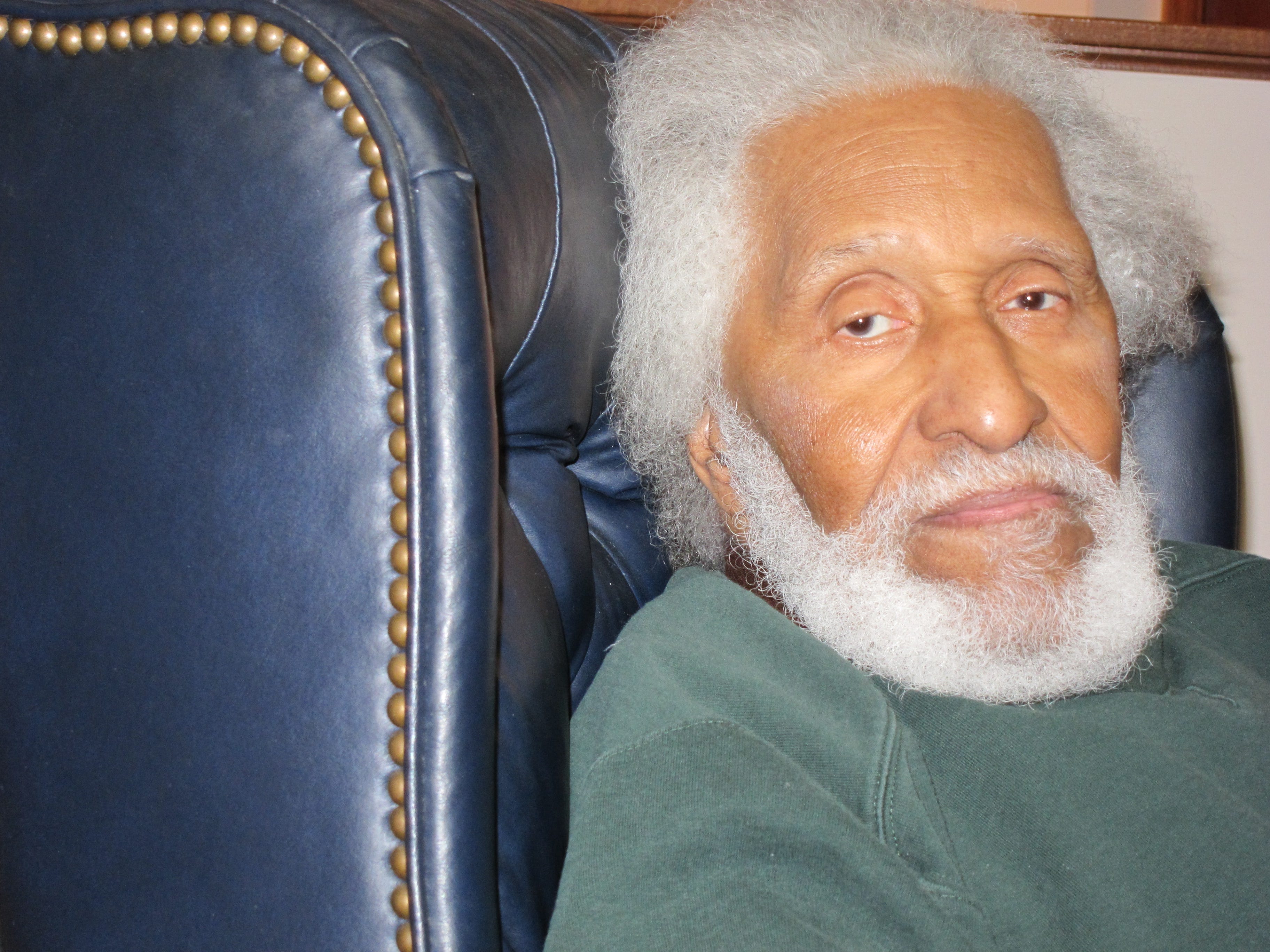
Sonny Rollins, who revolutionized the sound of the tenor saxophone in the early 1950s when most players modeled themselves after Coleman Hawkins or Lester Young, and the last living jazz musician from Art Kane’s “Great Day in Harlem” photographs for Esquire in 1958, died on Monday. He was 95. [Photo above of Sonny Rollins at home in early 2013 by Marc Myers]
Sonny was a complete artist and complex man. A deeply spiritual person who rolled up his sleeves to work hard and looked up to the heavens for guidance on how to live his life simply, Sonny knew he was special and among the best but couldn’t tell you why. Those things, he told me, were above his station in life.
Over the years, I had roughly 25 lengthy conversations with Sonny by phone. My first was in 2009, for a JazzWax interview (go here). Once we became friends, we spoke every month or two, and he was always effusive and supportive. I called him Mr. Rollins, and he called me Mr. Myers. He loved being old school.
In 2010, when I began writing for The Wall Street Journal, I had an idea for a profile. I approached Sonny’s publicist, Terri Hinte, with the concept. I wanted to hire a Town Car and take Sonny downtown to the locations of clubs still standing and long gone where he made a name for himself in the 1950s.
Terri had a better idea. “Why don’t you take him to his old neighborhood in Harlem,” she said. Sold. She reached out, he was overjoyed and I picked him up at his hotel on 57th St. on the appointed morning in August 2010. Away we went. For the next two hours, with my two tape recorders running, Sonny took me to the eight most important locations that shaped who he became.
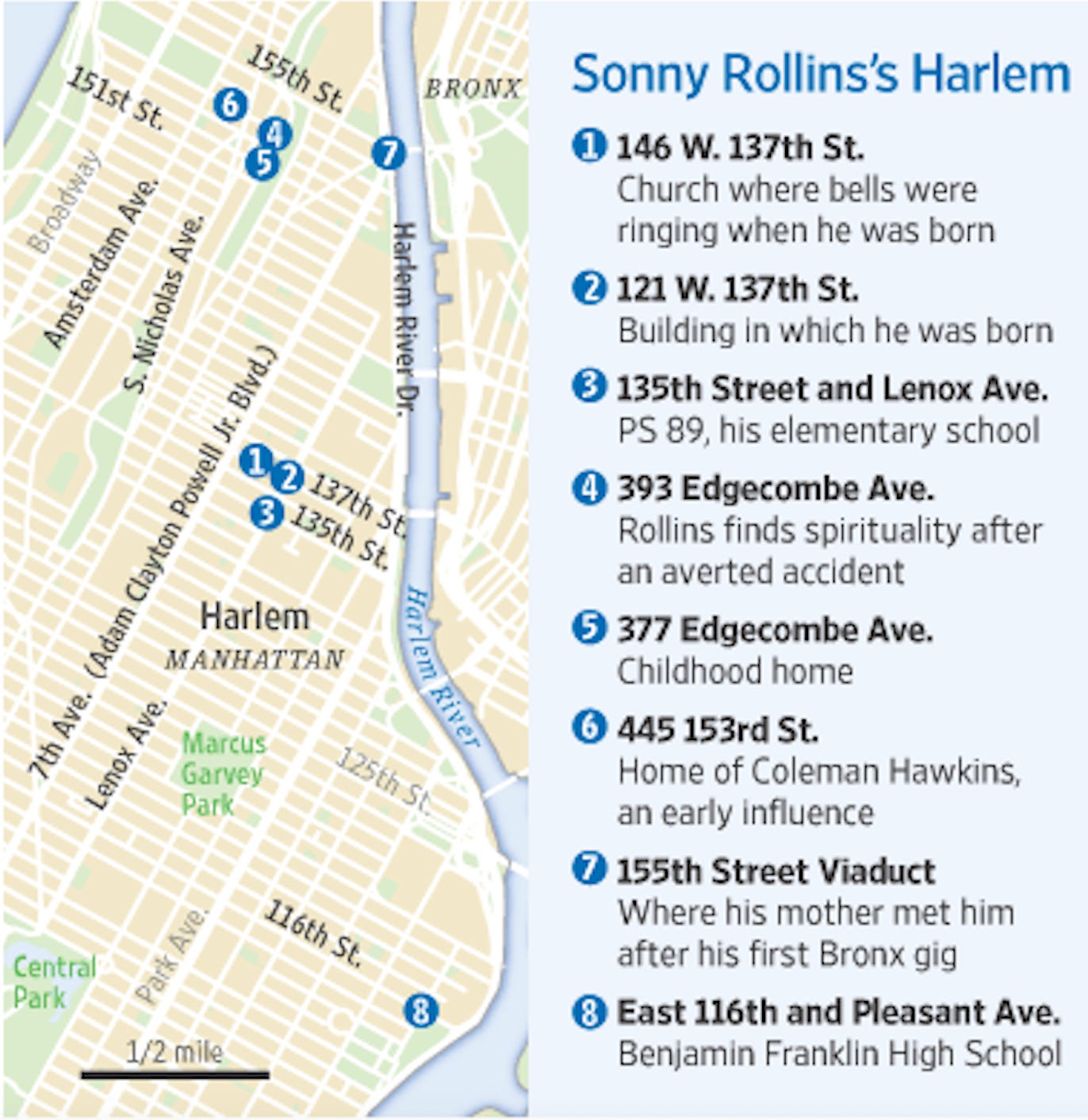
We went from the apartment building where he was born to his public school where riots nearly broke out in the mid-1940s between black and Italian kids. The riots were averted thanks to Frank Sinatra, who showed up to lecture everyone in the assembly on togetherness. Then he sang, and the tension was eased. Sonny never forgot the singer’s efforts that day and always loved his voice and records. [Graphic above courtesy of The Wall Street Journal]
The headline on my WSJ piece (go here) said it all: Sonny Rollins Takes a Ride Uptown. Sonny loved it, and from then on he knew he could talk to me openly and emotionally. One day I’ll have them all transcribed. I also visited him at home in 2013 for my House Call column (go here). To read my remembrance of Sonny on WSJ.com today, go here.
Sonny was notorious for never listening to his recordings. He said he was rarely happy with what he heard (“You hear me; I hear mistakes”). But over the years, I would bring up recordings and he’d tell me whether he was happy with them or not:
Sonny Rollins Quartet—I Know (1951)…
Sonny Rollins with the Modern Jazz Quartet—Scoops (1951)
Miles Davis With Sonny Rollins—full 10-inch album in 1954. Three Sonny originals and a standard…
Sonny Rollins and Thelonious Monk in 1954—full 10-inch LP…
Sonny Rollins: Tour De Force—Two Different Worlds (1956), with Earl Coleman on vocal…
Sonny Rollins Plus 4—Pent-Up House (1956)…
Tenor Madness—Paul’s Paul (1956)…
Sonny Rollins Quintet—Plays for Bird (1956) full album…
Sonny Rollins: The Sound of Sonny (1957) full album…
And Sonny Rollins—Alfie: Original Music From the Score (1966)…
More Sonny Rollins? WKCR-FM will celebrate the life and career of Sonny in a 48-hour memorial tribute, all day Friday and Saturday. To listen to the radio station from anywhere in the world, go here.
A friend of mine was the house pianist in a bass, drums and piano trio at a jazz club in NY, and Sonny was the guest artist one weekend.
As soon as he came in, he told the three musicians they could pack up their instruments and go home if they wanted to, he was going to play the whole four hour gig alone.
My friend stayed to listen. Sonny played the whole four hours and knocked everyone out
Great stories, links & tunes, thanks Marc! The idea to tour his childhood areas was excellent & interesting to see the map, but I still dig your idea about the downtown jazz club tour to remember gigs & fellow musicians which would have certainly been wonderful reminiscing stories as well!