

One of jazz’s most perplexing mysteries is how so many brothers wound up as exceptional jazz musicians. The list includes Wes, Monk and Buddy Montgomery; Cannonball and Nat Adderley; Ronnie and Hubert Laws; Conte and Pete Candoli; Jimmy, Percy and Tootie Heath; Wayne and Alan Shorter; Nat and Freddie Cole; Art and Addison Farmer; Stanley and Tommy Turrentine; Michael and Randy Brecker; and Wynton, Branford, Delfeayo and Jason Marsalis. I’m sure there are others I missed.
Perhaps the most celebrated fraternal jazz artists are Thad, Hank and Elvin Jones. Hank Jones was a prolific bebop pianist who recorded as a leader and sideman; Elvin Jones was an influential, revolutionary post-bop drummer who was most famously a member of the John Coltrane Quartet.
And Thad Jones may have been the most accomplished of the three. The cornetist and trumpeter was a composer, arranger and leader, a long-time member of the Count Basie Band and co-founder of the Thad Jones/Mel Lewis Big Band.
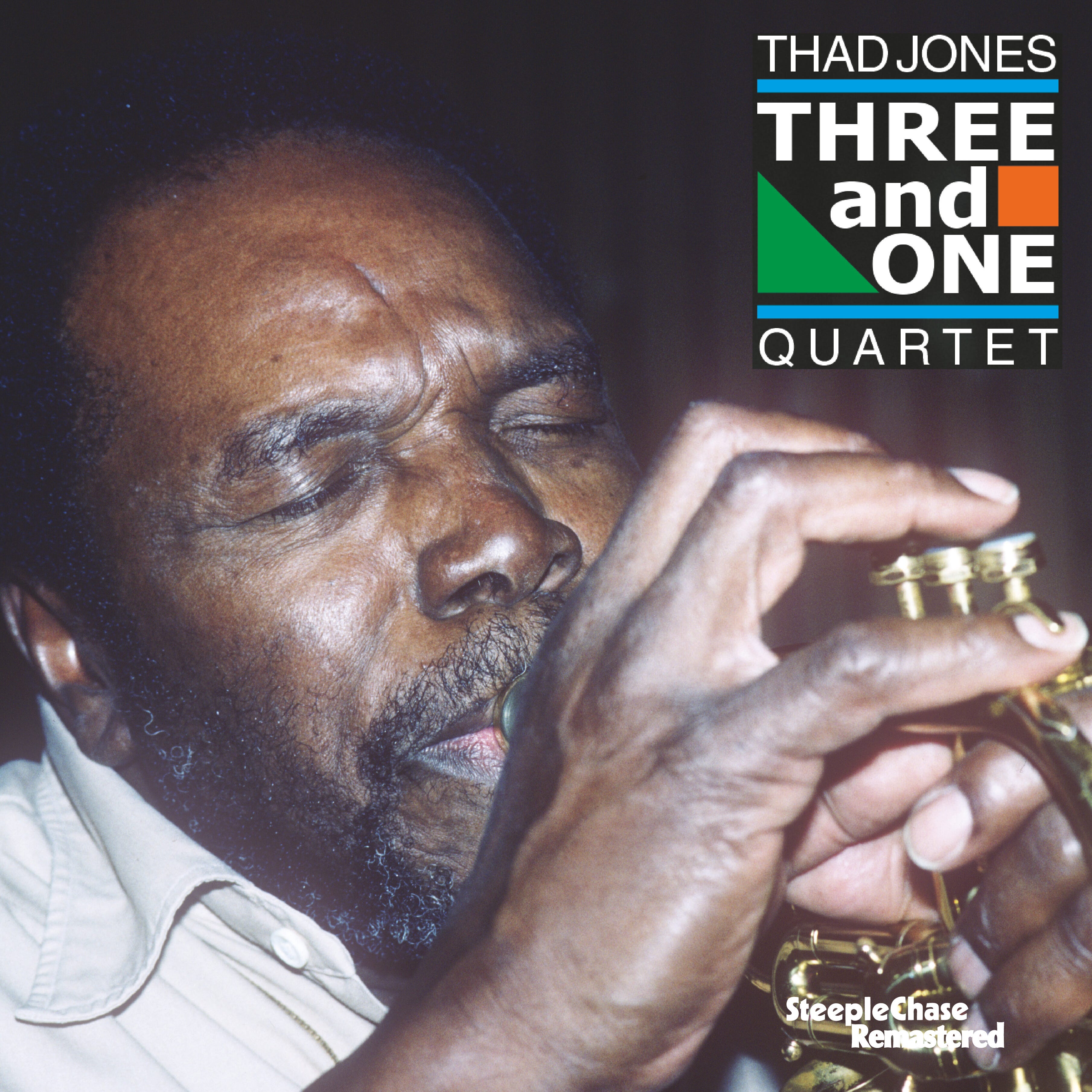
Now Nils Winther’s Steeplechase label in Denmark has remastered and re-issued one of Jones’s most interesting LPs from the 1980s—Three and One. Recorded in Copenhagen in October 1984, it features the cornetist two years before his passing, and he sounds superb.
The ensemble included Thad Jones (cornet), Ole Kock Hansen (piano), Jesper Lundgaard (bass) and Ed Thigpen (drums). What made Jones’s playing special was the personality of his horn. He could express notes in a forthright style, with a sense of humor when bending them and with an intimate swing. Whichever approach he chose, he added plenty of heat.
The album’s two sides feature six songs in all—Instant Blues Disinstant (Thad Jones), My One and Only Love (Wood-Mellin), But Not for Me (George Gershwin), Night Mist Blues (Ahmad Jamal), My Romance (Richard Rodgers) and Three and One (Thad Jones).
Born in Pontiac, Mich., in 1923, Jones was a middle child, with Hank being the oldest and Elvin the youngest. A self-taught musician, he began his professional career at age 16. During World War II, from 1943 to 1946, he served in U.S. Army bands. Jones joined Count Basie’s New Testament Band in 1954 and was featured on April in Paris, Corner Pocket and Shiny Stockings. He also wrote nearly two dozen arrangements for the band.
During this period, he recorded as a leader for Prestige. In 1963, he left Basie and eventually formed the Thad Jones/Mel Lewis Big Band in 1966, an orchestra that remained intact for 12 years. He taught at William Paterson College in New Jersey starting in 1972, becoming one of the earliest prominent jazz musicians to hold a full-time professorship. A year later he began serving as the founding director of the school’s jazz studies program.
In 1979, Jones left his position to move to Copenhagen where he married. He returned to the U.S. in 1985 to take over the Basie band following the Count’s death. Ill with cancer, he returned to Copenhagen in 1986 and died in August of that year. He was 63.
Among his small-group leadership albums in the 1950s are The Fabulous Thad Jones (Debut, 1954), Detroit–New York Junction (Blue Note, 1956), The Magnificent Thad Jones (Blue Note, 1956), Mad Thad (Period, 1957), The Jones Boys (Period, 1957), Olio (Prestige, 1957), After Hours (Prestige, 1957), Keepin’ Up with the Joneses (MetroJazz, 1958) and Motor City Scene (United Artists, 1959).
You’ll find Thad Jones’s Three and One (Steeplechase) in the U.S. at Dusty Groove here. The remastered album is also available on CD.
Here’s Instant Blues Disinstant…
And here’s But Not for Me…
I am very glad you have highlighted Thad as a player. So often in jazz, when folks who have a great talent for writing are often over looked as players. Benny Carter, Gerry Mulligan, Al Cohn, Benny Golson and J.J. Johnson also come to mind. Thad was always a very interesting soloist, who never went from point A to B to C. He always took an alternative route. The great Chicago disc jockey, Dick Buckley, told me a wonderful anecdote about Thad. He often sat with him in clubs when a band was performing on stage, and Thad would play obbligato on his cornet at the table. Dick said he never heard any better trumpet playing. In the one year that Thad led the Basie band, he also brought in another neglected soloist, Johnny Coles, who was a favorite of Gil Evans when not working with Miles.
As good as this album is, it was not Thad's "first quartet recording in 30 years." In fact, the Thad Jones-Mel Lewis Quartet with Harold Danko and Rufus Reid recorded an album in Miami in September 1977. This quartet (with Danko and either Reid or Chip Jackson) did a number of live gigs during this period. I.heard them for two nights at Blues Alley in Washington, DC, and they were stunning.