

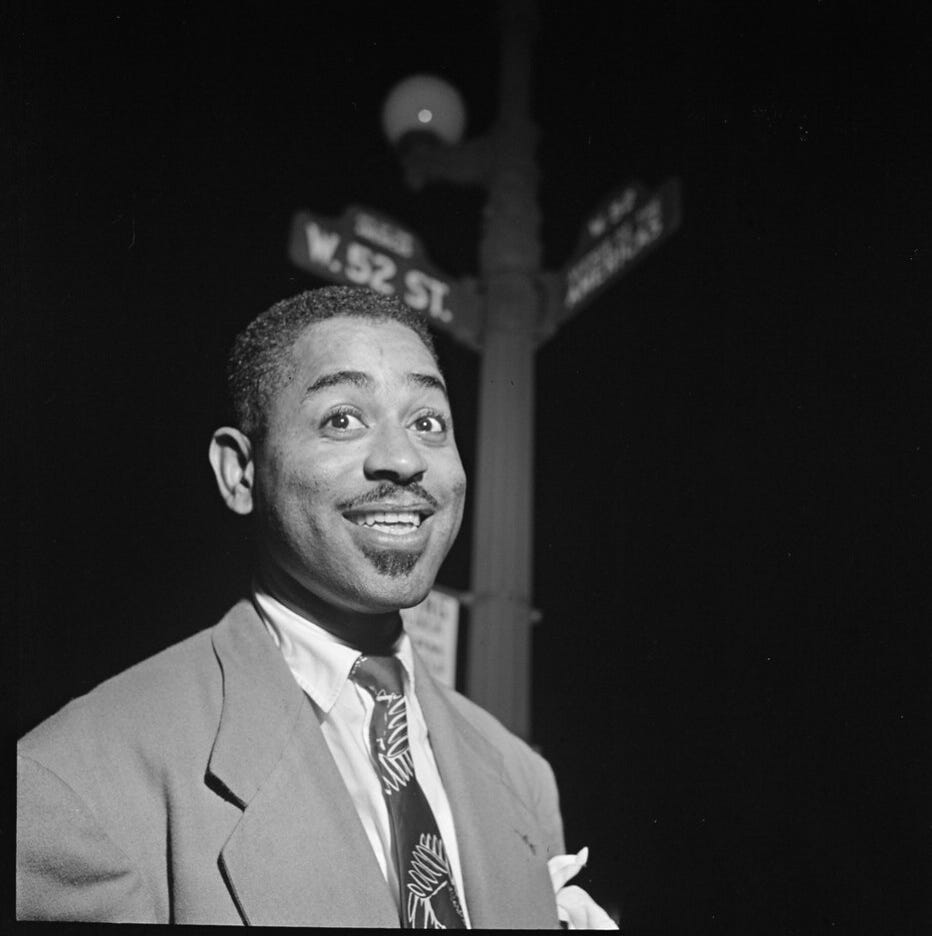
As far back as medieval times, well-known songs were routinely recycled as new compositions with slight modifications. Then came copyright law in 1710 to protect composers and a pivotal case in 1946 that allowed bebop to flourish in the 1940s. [Photo above of Dizzy Gillespie on Manhattan’s 52nd Street in 1947 by William P. Gottlieb]
The first landmark legal case over music copyright was Britain’s Bach v. Longman. Johann Christian Bach—the youngest son of Johann Sebastian Bach—and composer Karl Friedrich Abel took London music publishers James Longman and Charles Lukey to court in 1777. At issue was whether printed music was protected under the copyright regulations outlined in Britain’s Statute of Anne, enacted in 1710.
The court ruled in Bach’s favor, stating that printed sheet music did qualify as “writing” by its composer and was protected. America’s Copyright Act of 1790 was modeled after the Statute of Anne and protected original works, such as books and maps. Music was added to the Act in 1831.
Britain’s D’Almaine v. Boosey (1835) was the first case of a music publisher being successfully sued for plagiarism. The court established that turning copyrighted musical themes into dance arrangements did indeed constitute copyright infringement.
In the years ahead, the focus of music copyright law centered on song melodies. Cases brought to court by composers who claimed new songs used their original song’s chord progressions were routinely thrown out. Courts viewed chords as unprotected under copyright law, since they were akin to words vs. original ideas articulated in paragraphs. By contrast, melodies were considered creative thoughts and therefore protected.
Then came Arnstein v. Porter (1946), which ironed out the nettlesome issue of what constituted similarity between two songs and set standards for proving song theft.
Ira Arnstein was a professional songwriter who claimed that Cole Porter had sent spies to steal his songs, notably The Lord is My Shepherd and A Mother’s Prayer. The specific Porter hits at issue were Don’t Fence Me In, Begin the Beguine, I Love You, You’d Be So Nice to Come Home To and My Heart Belongs to Daddy.
The trial court ruled on behalf of Porter, who claimed he had never heard Arnstein’s songs and that there was no substantial similarity between the melodies. Arnstein appealed and lost, but the case led the appellate court to establish two elements for copyright infringement:
First, there had to be evidence that the defendant being sued had to be aware of the work (through widely circulated sheet music and recordings).
Second, there had to be evidence that the songs were substantially similar. In other words, chords by themselves were not grounds for copyright infringement, only original melodies of published compositions.
This case allowed the emerging bebop movement in 1946 to flourish. Bebop songs that featured original melodies using the chord progressions of standards were immune from royalty payments or litigation. While this trend had started among early bebop musicians in 1945 with Parker’s Ko-Ko (Cherokee) and Dizzy Gillespie’s Groovin’ High (Whispering), Parker and Gillespie were on thin ice, which is probably why they masked the chord progressions with fast, complex melodies.
Arnstein V. Porter in 1946 clarified what was problematic and what wasn’t. Not only could original bebop melodies be published without fear of royalty payments and litigation but they also could be parlayed on recordings, sheet music and in concert.
And those new bebop melodies were now protected. So rather than relying solely on the blues as a rights-free foundation for melodies, more bebop musicians began using chord progressions of popular songs to create newly improvised melodies.
It’s doubtful bebop musicians knew that this case had opened the door for them. More likely, music publishing companies with attorneys informed them or a record label that handled their publishing filled them in on what was fair game.
In the wake of the case, dozens of bebop songs began surfacing in the 1940s that were based on the chord progressions of standards, giving rise to what we now call contrafacts.
These contrafacts included Charlie Parker and Benny Harris’s Ornithology, (which was based on the chord changes to How High the Moon); Miles Davis’s Donna Lee (Back Home in Indiana); Parker’s Scrapple From the Apple (Honeysuckle Rose); Parker and Dizzy Gillespie’s Anthropology (I Got Rhythm); and Miles Davis’s Dig, Clifford Brown’s Sweet Clifford and Thelonious Monk’s Bright Mississippi (Sweet Georgia Brown).
To show you how ingenious bebop musicians were using the chord progressions of standards to create new melodies, let’s listen to a few pairings:
Here’s Benny Goodman’s How High the Moon in 1940, the first recording of the song…
And here’s Charlie Parker and Benny Harris’s Ornithology in 1946…
Here’s the first recording of Back Home in Indiana by the Sterling Trio in 1917…
And here’s Charlie Parker and Miles Davis in 1947 playing Davis’s Donna Lee, which uses the same chord progressions…
Here’s the first recording of Sweet Georgia Brown, by Ben Bernie, in 1925…
And here’s Miles Davis’s Dig, in 1951…
"Dig" is also known as "Donna" (I first heard the tune on a two-fer Miles Davis LP compilation under that name and was confused when I heard the same tune later with the "Dig" title). It's my understanding that the tune was written by Jackie McLean (who was on the recording session) and incorrectly credited to Miles. Don't know whether Davis or McLean received royalties on the tune, or whether Miles credited McLean at some point with authorship -- maybe some of Marc's more academic readers know this.
Pre-bebop, Ellington was a prodigious composer of contrafacts, with an unusual fondness for the chords of Tiger Rag. See (or listen to) High Life, Hot and Bothered, the virtually impossible to play Braggin' in Brass, and Daybreak Express. His Stompy Jones was famously based on the chords of Happy Birthday to You!
As a long time super fan of Jazz Wax, and a retired IP Attorney (registered patent lawyer, with 30 years experience with trademarks and copyrights as well, wanted to post kudos to Mark for being spot on with this article. Many if most of the public mix up copyright with patent and trademarks as well. So, this was among other good things, a straightforward and accurate account of some 300 years of jurisprudence starting with Queen Anne. Two things to amuse and educate, who in the USA pretty much established the US Patent Office and was its first director? Thomas Jefferson, who had been impressed with the French efforts while he was there in the revolutionary period. Second, what US President was the first US patent holder, and for what? Abraham Lincoln, while in the Illinois period of his history, for a method and system to remove steamships from shoals.