

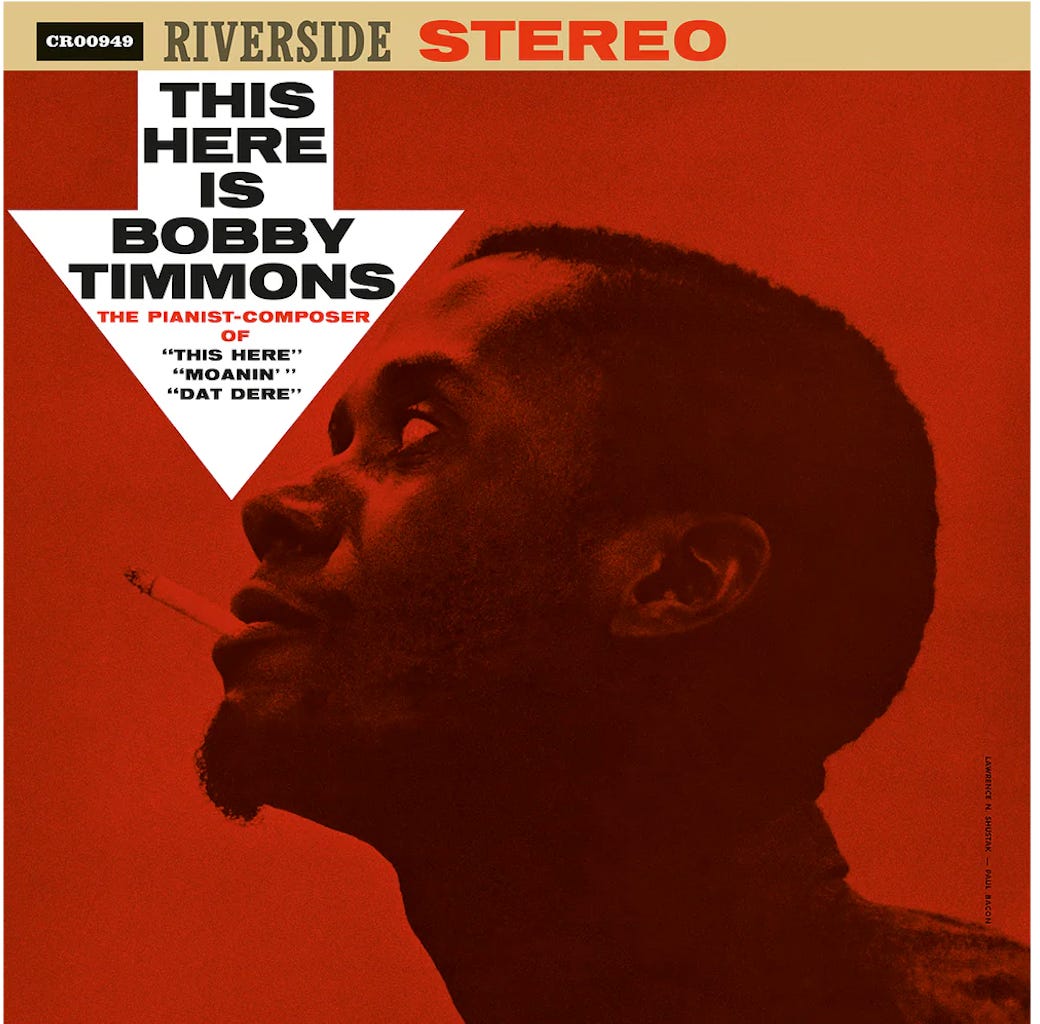
By the time pianist Bobby Timmons recorded This Here Is Bobby Timmons in January 1960 for Riverside, his first studio album as a sole leader, he had been recording and touring as a sideman for four years.
Among his sideman-LP winners were Kenny Dorham’s ‘Round About Midnight at the Cafe Bohemia (1956), Chet Baker’s live concert at Los Angeles’s Forum Theatre (1956), Anthony Ortega’s Jazz for Young Moderns (1957), Hank Mobley’s Hank (1957), Curtis Fuller’s The Opener (1957), Maynard Ferguson’s Boy With Lots of Brass (1957, Lee Morgan’s The Cooker (1957), Art Blakey and the Jazz Messengers’ Moanin’ (1958)—at which point he recorded and toured with Blakey—and The Cannonball Adderley Quintet in San Francisco (1959), when he was a member of that group, too.
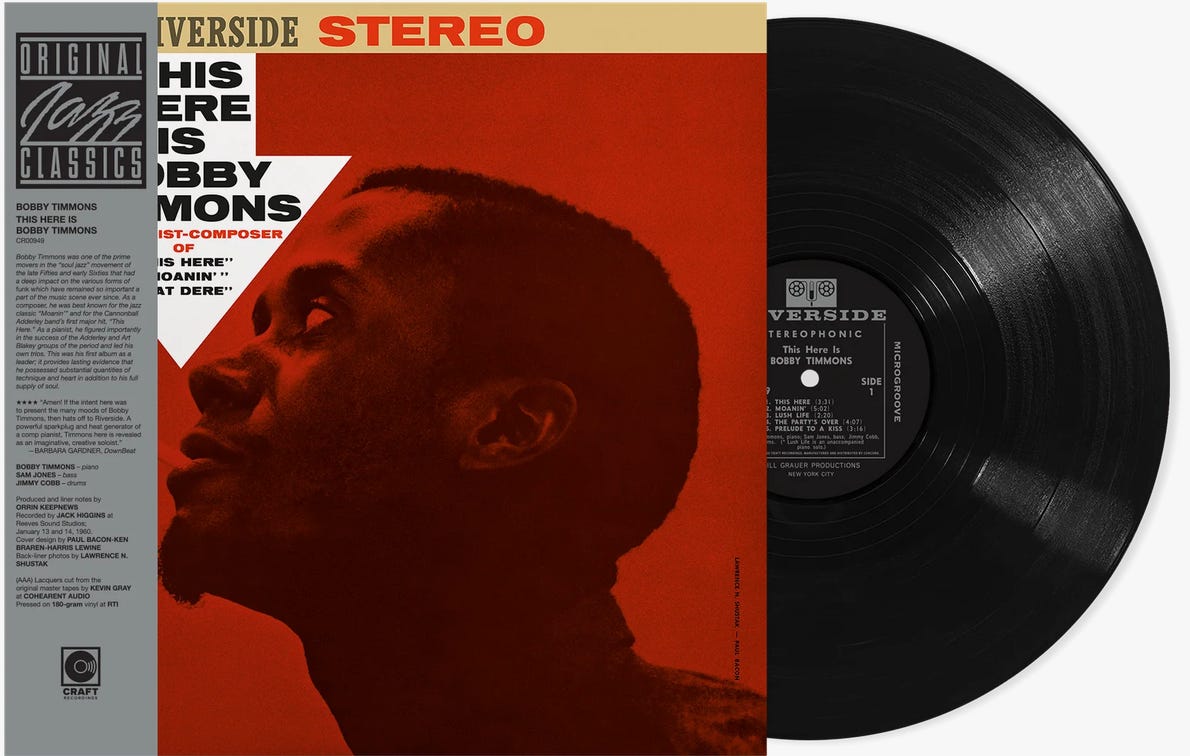
Now, Craft Recordings has released This Here Is Bobby Timmons on 180-gram vinyl, with lacquers cut from the original tapes by Kevin Gray at Cohearent Audio, and tip-on jackets, replicating the original artwork. The album will also be released digitally in 192/24 hi-res audio. The trio featured Timmons (p), Sam Jones (b) and Jimmy Cobb (d).
In many ways, this LP is one of the first soul-jazz releases, setting the stage for an entire genre in the 1960s. It also shows off Timmons’s gospel-jazz feel that would be mirrored by many other players. Timmons was known for his energy and earthy grace on the keyboard, and his contribution remains overlooked and under-celebrated. The deterioration of his health and his early death were a tragedy.
Timmons was born in Philadelphia in 1935. His uncle, Robert, played piano and taught Timmons at age 6 in 1941 before also taking on pianist McCoy Tyner. Timmons began playing in front of an audience at the church where his grandfather was a minister.
After graduating from high school, Timmons received a scholarship to study at the Philadelphia Musical Academy. When his studies were completed in 1954, he moved to New York. His first significant showcase album was Moanin’. He had written the title track. When I interviewed Benny Golson in 2008, who had been a member of the Jazz Messengers at the same time, I asked him about Timmons and his composition. Here’s what Golson said:
JW: Bobby Timmons’s Moanin’ was on the same album. What role did you play in that song’s creation?
BG: I just pushed Bobby to take it seriously. Bobby used to have a lick he liked to play every time we finished a tune. He’d play what would become Moanin’s theme. Then he’d stop and laugh, and say, “Ah, that sure is funky.” That went on for a few weeks. By the time we got to Marty’s, a club in Columbus, Ohio, he had the first eight bars, the second eight and the last eight. All he needed was a bridge.
JW: How did the bridge come about?
BG: I called a rehearsal. Everyone wanted to know why we were rehearsing, since we had the band’s book down. I said we were going to do something new. At the club, I told Bobby we were going to put a bridge on the song he always played in between tunes. He said, “That thing? Oh that’s nothing. That’s just an old lick.” I said, “No Bobby, I hear a tune there. We’re all going to sit down here, and you’re going to go up on the bandstand and write a bridge to the tune. He didn’t want to do it. I said, “Trust me, this is the making of a great tune. Write a bridge.”
JW: What did he do?
BG: We went and sat down. After about a half hour, Bobby said, “Come see what you think of this.” I came up and he played it. I said, “No, no Bobby, it misses the point. You don’t have the same groove as the other melody.” He says, “Well you write it then.” I said, “No, this has to be you, Bobby. Come on, try again.” I sat back down, and about 15 minutes later, Bobby said, “Here it is.” I listened and said, “That’s it!” We learned the tune, played it that night and got everyone in the audience up dancing.
In addition to Moanin’, Timmons’s trio album featured two of his other best-known songs—This Here and Dat Dere, which later was given lyrics by Oscar brown Jr. and recorded on his album Sin & Soul, released in 1960. Two years later, vocalist Sheila Jordan recorded it on her debut album Portrait of Sheila.
Like a number of jazz musicians during this period, Timmons became addicted to drugs and alcohol, which greatly compromised his career by the late 1960s. In the early 1970s, touring became difficult due to unreliability. In 1974, he collapsed while on tour. He would die a month or so later of cirrhosis of the liver in New York in March 1974. He was 38.
You can read my interview with Benny Golson here.
To buy the vinyl, go here. To buy the download, go here.
Here’s Moanin’. Listen for Timmons’s brilliant locked-hands passage, and dig the tag he added of Peggy Lee’s Why Don’t You Do Right, recorded with Benny Goodman in 1942…
Here’s Peggy Lee’s hit (dig Louie Bellson’s stick twirls in the background at the opening, that’s a bass sax on the left and Dave Barbour, who would become Lee’s husband, is on guitar)…
Here’s This Here…
Here’s Dat Dere…
Here’s Oscar Brown Jr.’s cover of Dat Dere with his lyrics…
Here’s Sheila Jordan…
And here’s Brown on the Ed Sullivan Show in April 1961. Brown missed the first lyric line to be sure the child was off the slide before he recovers flawlessly on the second line…
Bonus: Here’s Timmons with Art Blakey and the Jazz Messengers playing Moanin’ live in Scheveningen, the Netherlands, in 1958, with Art Blakey (d), Lee Morgan (tp), Benny Golson (ts), Bobby Timmons (p) and Jymie Merritt (b). An astonishing Timmons solo…
Moanin’ the song and Moanin’ the album was what got me hooked into jazz. When I first heard the song it was like a bulb exploded in my head. Still love the album. Nothing against Wayne Shorter but Golson was the perfect tenor for the JMs, in my opinion, of course. Great story about how Bobby wrote the bridge. Thanks.
That is one of the best solos I’ve heard Bobby play. I wish the camera stayed on him. I have heard Benny Green channel him on numerous occasions. Lee Morgan always concluded his solo with the “Big Fat Mama” quote. Benny Golson picks it up with his solo. Funny Cannonball lured him away from Art, after he had written the hit “Dat Dere.” He wrote “Dis Here” for Cannon and it also became a hit. If memory serves Bobby rejoined the Messengers after that. What a tragedy he drank himself to death in his thirties. What a great talent.