

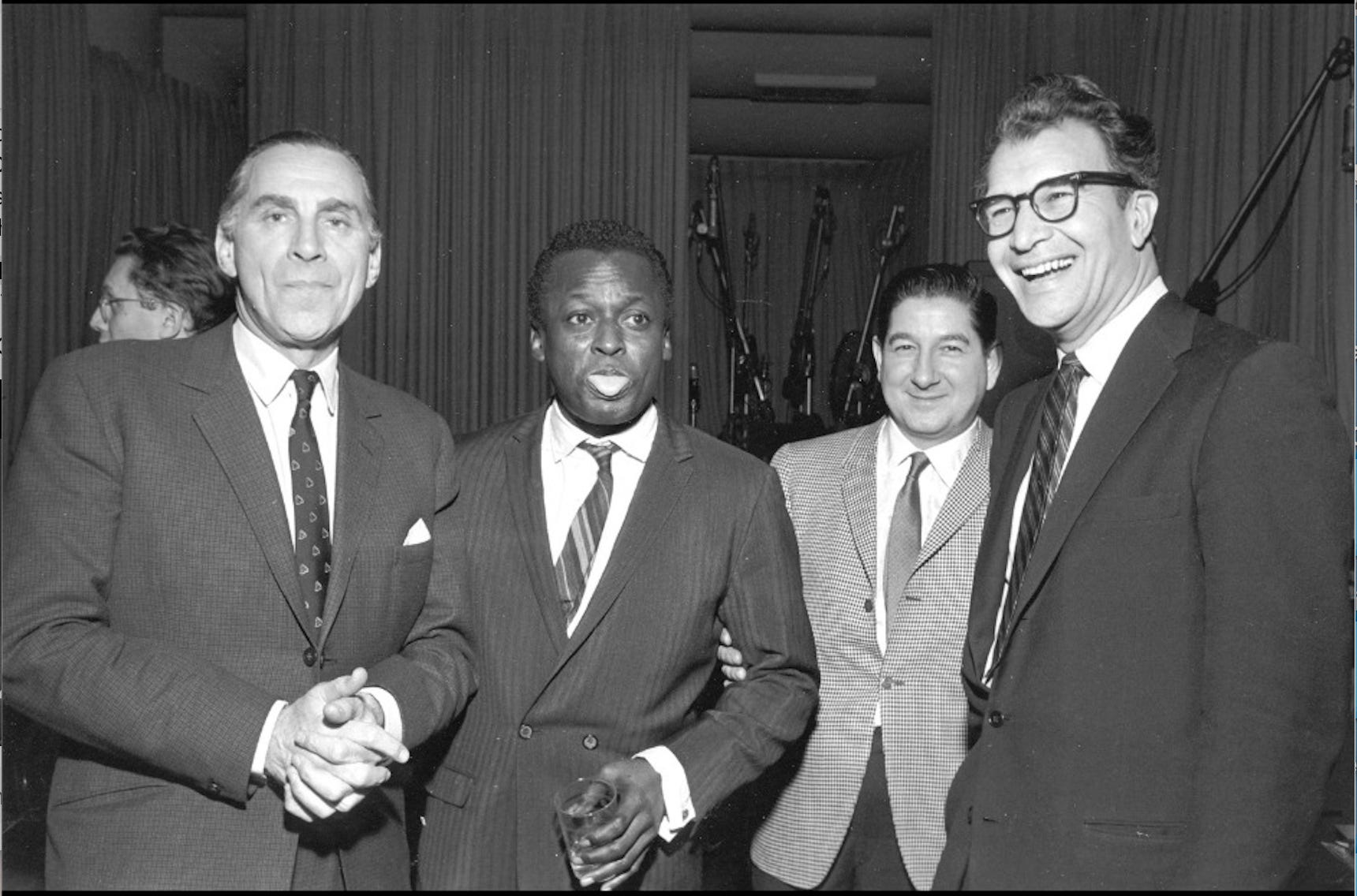
We listen to jazz today and just assume that because the music wound up on records, everyone in the country took it seriously. That was hardly the case. Jazz was ignored for large chunks of time or viewed despairingly as the music of alcoholics, prostitutes, drug addicts and gangsters. Not until 1957 did jazz achieve a high level of respect nationwide, on par with classical, and that golden era lasted only eight years. [Photo above, from left, Goddard Lieberson, president of Columbia Records; trumpeter Miles Davis, Columbia producer Teo Macero and pianist Dave Brubeck in the early 1960s]
Jazz was first performed in American classical concert halls as early as May 2, 1912, when James Reese Europe and his Clef Club Orchestra played New York’s Carnegie Hall. On Feb. 12 1924, George Gershwin played piano in a performance of his composition Rhapsody in Blue, while Paul Whiteman conducted his Palais Royal Orchestra at New York’s Aeolian Hall.
With the arrival of Prohibition between 1920 and 1933, jazz became the music of speakeasies, sex workers, rum-running mobsters, boozing musicians and privileged college students. In other words, jazz became exotica and music of the underworld and underground.
Big bands adapted jazz for the swing syncopation needed to fill dance halls in the 1930s. Many of the major bandleaders were formally trained on the clarinet, so the works of classical composers were familiar to them. Duke Ellington, Artie Shaw, Benny Goodman, Woody Herman, Boyd Raeburn and others recorded classically inspired jazz pieces. On Jan.16, 1938, jazz was performed at Carnegie Hall when Benny Goodman was recorded there with his small group and big band before a packed house.
The big band era gave jazz a much-needed post-Prohibition rehabilitation, but it was happening mostly in New York and a few other cities. With the rise of bebop in 1946, jazz went into clubs, where it became the music of soldiers on leave, smokers, drinkers, hipsters on a first date and college students in the know.
Then three things happened in the 1950s: the affordability of home phonograph consoles housed in living rooms, the widespread popularity of rock ‘n’ roll and the acquisition of television sets.
The phonograph allowed adults to explore different types of music through mail-order record clubs like Columbia House. The music could be consumed at their leisure from their sofas. Rock ‘n’ roll was viewed by parents as corrosive to their relationship with their kids; and the television set established national standards of humor, musical enjoyment and behavior that fed advertising’s American Dream.
How did all of these trends help to boot jazz’s reputation? One could order jazz LPs that were easy for the average ear to absorb and understand at home—including records by Duke Ellington, Dave Brubeck, Louis Armstrong, Ella Fitzgerald and Miles Davis.
With the music of Elvis, Little Richard, Chuck Berry and others playing adversarial roles in households, parents began looking for music with an edge that made them feel young outside of the classical and pop realms. That was motive enough to begin acquiring a taste for jazz.
And the appearance of TV sets in more households by 1957 led to network television broadcasts that not only entertained but also educated viewers.
Such programming was driven by the wives of executives who ran TV networks, ad agencies and consumer goods companies. Many collected modern art, knew the names of famed architects, attended the opera and ballet and understood the value and excellence of high culture. When it came to the arts, these spouses had no patience for racial discrimination.
NBC aired the Nat King Cole Show (1956-‘57) and the Steve Allen Show (1956-’60), exposing a national audience to jazz and jazz-pop singers and musicians. CBS broadcast Patti Page hosting The Big Record (1957-’58), which often featured jazz-pop singers. The network also broadcast the Ed Sullivan Show, which routinely showcased jazz-pop artists.
But the TV show that allowed jazz to be universally thought of as high culture was CBS’s airing of The Sound of Jazz, the December 8, 1957 edition of the CBS television series The Seven Lively Arts. Also significant was Robert Herridge’s The Sound of Miles Davis, on April 2, 1959.
Jazz was finally invited to the high-brow table, and seeing the genius of Billie Holiday, Lester Young, Coleman Hawkins, Gerry Mulligan, Count Basie and others on TV made the greatness of these artists impossible to ignore, putting them in the same league as the symphony and chamber group musicians.
Also vital to jazz’s transition from low-culture to high culture was Leonard Bernstein, whose songs for Broadway’s West Side Story (1957) wound up on jazz albums, making those LPs more appealing. By then, Bernstein had already composed works paying homage to jazz, including Prelude, Fugue and Riffs and Symphony No. 2: The Age of Anxiety (both in 1949). He also explored jazz in his Young People's Concerts (Jazz in the Concert Hall in 1964) on CBS and his famous What Is Jazz episode.
Others vital to helping jazz become high culture were Nat Hentoff, whose album liner notes, books, album and TV show production helped develop a high-brow taste for and understanding of the music.
Jule Styne and Stephen Sondheim, whose score for Gypsy (1959) fine-tuned the ear for jazz. Norman Granz, whose Jazz at the Philharmonic tours brought jazz all-stars into concert halls in the U.S. and abroad.
George Wein, who in 1954 launched the Newport Jazz Festival, which created a daytime and evening space for jazz outdoors.
Columbia Records jazz head George Avakian signed Miles Davis to the label and was instrumental in helping to release major recordings by jazz artists in the 78 and 10-inch and 12-inch LP eras.
And radio DJs including “Symphony Sid” Torin, Fred Robbins, Holmes “Daddy-O” Daylie and Arthur “Turntable” Pearce who supported live jazz and played jazz records on the air.
As kids exposed to jazz entered their teens in the 1960s, there was no holding them back from the pop-rock appeal of the Beatles and Rolling Stones and hard-rock lure of Led Zeppelin and the Who. Jazz-rock fusion of the 1970s appealed to college students. And those kids who had been captivated by jazz in the early ‘60s moved on to light pop, soul-jazz and even rap.
All of this left jazz without a young core audience, and the music began its slow shift toward cultural oblivion. This isn’t a jazz obit or an essay on who killed jazz. Nor is it a long attempt to point out again that the New York Times Sunday Magazine doesn’t think jazz was worthy enough to include at least Sonny Rollins or Herbie Hancock in its “30 Greatest Living American Composers” list.
Rather, it’s merely to point out that between 1957 and 1964, jazz became high-culture after winning the respect of Fifth Avenue socialites and Main Street TV-watchers. It was a golden time for jazz, when the color of a jazz musician’s skin was meaningless and integrated jazz groups proved to America that race didn’t matter at all when it came to musical excellence and exceptionalism.
I’ll leave you with this: Here’s Nat King Cole in 1957 singing Tenderly on his TV show backed by Oscar Peterson, Ray Brown and Herb Ellis. What’s not to love?…
As a jazz historian, you surely had significant events in mind, that defined the period when jazz was accepted as a high art form. It's interesting for me personally, that a very large segment (perhaps majority) of my favorite recordings are from the period 1955-1962. So, I track with your time frame, but lag a bit chronologically. I feel that many recordings after 1962, had an edge that gave the music a different feel, including that recorded by the same musicians I had enjoyed earlier (i.e., Blue Note). Modality entered the mix, as well as, the influence of civil rights activism. Big bands were scuffling to survive & incorporated music from the British Invasion into their playbooks. It became a confusing time for old school mainstream jazz fans, such as myself. For me, most Fusion recordings were an abomination. They had created a soulless hybrid that lacked any identity. Of course, there were still folks like Ellington, Basie, Horace Silver & the MJQ, as well as, the lovely music blowing up from Brazil, to cling to. (And even Creed Taylor couldn't completely destroy the genius of Wes Montgomery!)
Goddard Leiberson’s role should be underscored. Never has a major record company had such a musically literate person in charge. Most you can name, in the memorable words of Woody Herman, never listened to anything but their electric shaver. Goddard had a legitimate classical music background, but recognized the artistic merit of jazz without having to be convinced. George Benson is the only person I know who knew him. George and Aretha Franklin were both signed to Columbia about the same time. In spite of John Hammond’s best instincts, Columbia didn’t know what to do with them. George told me they were trying to produce Aretha the same way as Barbra Streisand. As for George, they didn’t know if he should be a jazz guitarist or pop singer. Goddard suggested they both be released after two albums. Aretha went to Atlantic, George went to Verve. They both flourished. His instincts proved to be right.