

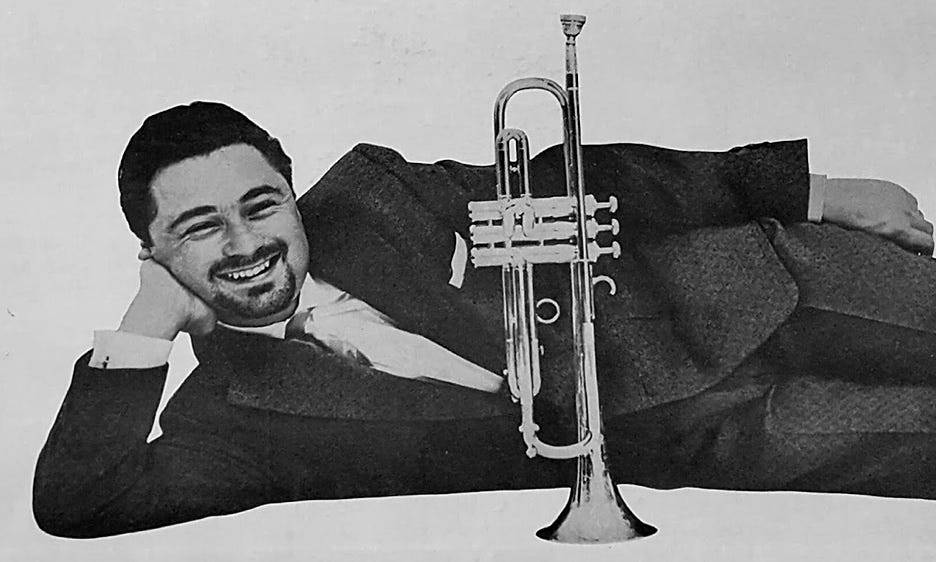
Today marks the 102nd birth anniversary of Shorty Rogers, who, with Gerry Mulligan, helped launch West Coast jazz in the early 1950s. The sound was airy, punchy and catchy and came to represent a new movement that captured the relaxed and idyllic lifestyle and temperate weather of Southern California.
Rogers, like Mulligan, was a master of contrapuntal composing and arranging, He also was a veteran of two superb post-war big bands—Woody Herman and Stan Kenton. Tired of cross-country tours and months away from his family, Rogers left Kenton to start his own all-star band, Shorty Rogers and His Giants, and settled in Los Angeles’s San Fernando Valley.
Less explored by jazz writers was Rogers’s influence on the composers of TV show themes in the 1960s. All knew they had just a minute to grab and hold viewers and then send them off with the theme stuck in their heads at the end so they’d return the following week. Rogers’s swinging approach in the 1950s was the perfect model for television a decade later.
Rogers was the first to bring the jazz sound to Hollywood’s film noirs in 1953 with his arrangements of jazz themes for The Wild One, and in 1955 with the score for Man With the Golden Arm. Johnny Mandel’s score for I Want to Live wouldn’t appear until 1958 and Henry Mancini’s Peter Gunn arrived that same year.
Rogers’s upbeat, tight arranging style had a big influence on Hoyt Curtin (The Flintstones, The Jetsons), Sid Ramin (The Patty Duke Show), Richard Wess (I Dream of Jeannie), Jack Keller (Bewitched, Gidget), Lionel Newman (The Many Loves of Dobie Gillis) and many others. All were fully aware of Rogers’s dramatic jazz style and Basie-esque approach.
Rogers is credited as providing the end theme for The Partridge Family sitcom and served as the show’s initial music director. He also was brought in as a score doctor for The Mod Squad, Starsky and Hutch, Fantasy Island, The Rookies, Vega$, Tabitha and Viva Valdez.
Here are clips of Rogers’s music in the 1950s, which served as a model for a generation of TV-show composers. As you listen, you can hear the essence of the style used for opening and closing themes:
Here’s Powder Puff (1953)…
Here’s Coup de Graas (1953)…
Here’s Rogers’s arrangement for The Wild One, from the film The Wild One (1953)…
Here’s Cool Sunshine from East Coast-West Coast Scene (1954)…
Here’s Isn’t It Romantic from The Swinging Mr. Rogers (1955)…
Here’s Audition from Man With the Golden Arm (1955)…
Here’s A Ship Without a Sail from Shorty Rogers Plays Richard Rodgers (1957)…
Here’s A Geophysical Ear from Portrait of Shorty (1957)…
Here’s No Such Luck from Chances Are It Swings (1958)…
And here’s If I Only Had a Brain from The Wizard of Oz and Other Harold Arlen Songs (1959)…
Bonus: Here’s Shorty Rogers and His Giants at Japan’s Aurex Jazz Festival in 1983 playing Infinity Promenade, with Shorty Rogers (flhrn), Bud Shank (as), Jimmy Giuffre (ts), Bob Cooper (ts), Bill Perkins (bs), Pete Jolly (p), Monty Budwig (b) and Shelly Manne (d)…
Thanks to Todd Selbert for the Shorty reminder.
I’ve read that Sinatra had a great debt of gratitude for Shorty. Not only for the score of “Man with the Golden Arm”, but also coaching him on the ways in which a jazz musician would act.
Just heard all the tracks and saw the clip from the Aurex Jazz Festival. As always, great selection. 👍
I hope it's okay if I point out a book that really inspired me:
"Music for Prime Time - A History of American Television Themes and Scoring" by Jon Burlingame
https://global.oup.com/academic/product/music-for-prime-time-9780190618308